
🕯️ Full Story (≈1,050 words)
It always began with a clock.
Not a normal clock, but a heavy, old-world clock with brass hands that moved like the wings of a slow bird. In the dream, Nora was already running late. She didn’t know for what—an exam she hadn’t studied for, a train that would leave with or without her, a ceremony where her name would be called and no one would rise. The details changed. The feeling never did.
Her shoes were never where she left them. Her bag was full of everything except what she needed. The streets rearranged themselves like a puzzle that resisted being solved. She would sprint toward a door only to find it bricked over, or finally reach the station as the last carriage slid away soundlessly, carrying a thousand versions of her who had arrived on time.
Sometimes the dream chose a school hallway, lit a little too bright, lockers stretching like a spine. She’d pat her pockets searching for a pencil, a paper, a clue, anything that explained why she was here. She’d glance at the clock and feel the second hand scrape across the minute like a nail across glass. It hurt. Time hurt.
One night, the dream chose an airport. She was late for a flight to see someone who mattered—someone whose voice in waking life had grown distant. The terminal gleamed. An announcement filled the air like a low hum. “Final boarding.” She ran. People turned into gentle obstacles, drifting in front of her like fish in a slow river. Her legs moved, but the floor lengthened with each step, the gate drifting farther like a mirage. She reached it just as the door closed with a polite, irrevocable click.
“Please,” she said to no one in particular. “Please.”
A figure in a navy blazer looked up with eyes that seemed too kind for an airport and said, “Time isn’t leaving you. You’re leaving yourself.”
Nora woke with the sentence echoing in her ribs.
It kept happening, every week, then every few nights, always some version of being late. Late to apologize. Late to forgive. Late to choose. The morning after each dream, she moved through her day with that metallic taste you get when a truth is trying to surface. She’d sip her coffee and feel the clock in the kitchen breathing. She’d scroll her phone and hear a tiny ticking inside the silence.
One afternoon, after a long day of doing things that looked like living, Nora sat in her car and stared at the steering wheel. She realized she had become an expert at almost. She almost started the book. She almost booked the trip. She almost asked for the truth and almost told hers. Almost had become a country she knew too well, with maps and roads and familiar excuses. The dreams were not nightmares; they were maps she kept refusing to read.
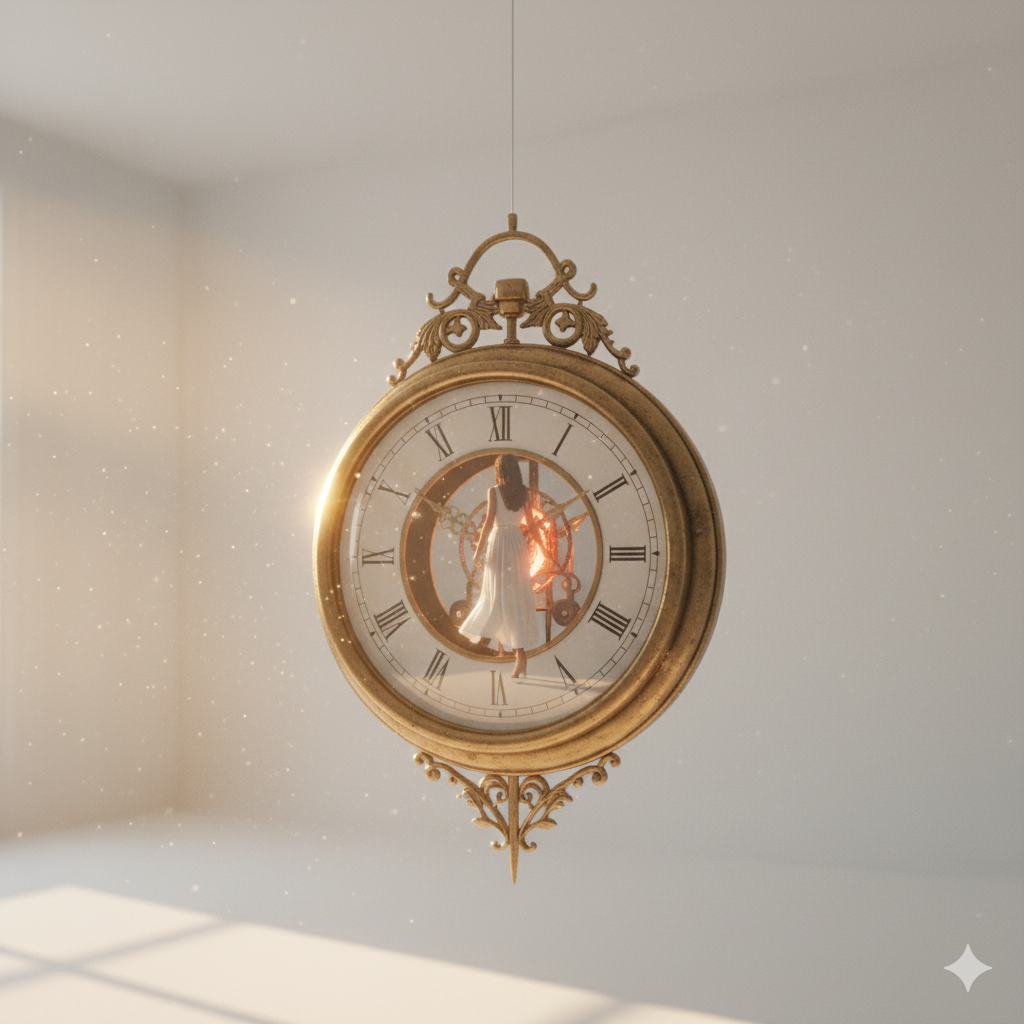
That night the dream returned, but it was different. No school. No airport. No train. Just the clock. It hung in a white room that felt both vast and intimate, like the inside of a held breath. The brass hands moved—but when she listened closely, they weren’t ticking. They were singing. A quiet, patient melody. A lullaby for the parts of her that had waited too long.
“Why am I always late?” she asked. Her voice didn’t echo. It soaked into the white walls like water into linen.
A presence gathered, not a person, more like the way light gathers behind your eyelids when you turn toward the sun. It wasn’t outside her. It was her—older, wider, kinder.
“Because you are waiting for permission,” the presence said. “From clocks, from doors, from faces, from silence. You learned to run after time instead of meeting it in the middle.”
“I’m tired,” Nora said. “I’m tired of missing my life by a few minutes.”
The presence didn’t speak for a while. She could feel it thinking the way you feel a tide turning inside the ocean.
“Time,” it said at last, “is not a hallway with locked doors. It is a room that expands when you tell the truth. Every dream you’ve had is a threshold. You keep arriving at the threshold and asking the threshold if you’re allowed to cross. Cross.”
The clock’s hands slowed. Not stopping—softening. The brass brightened until the whole face glowed like a small moon. The room warmed. Nora felt something in her chest unclench, a fist that had been holding her breath for years. She thought of the text she hadn’t sent, the apology she owed, the canvas in her closet, the idea that kept visiting and leaving because she never invited it to stay.
“What if I’m late already?” she asked. “What if I missed it?”
The presence smiled through her. “Beloved, you are on time for your own life the moment you answer it.”
The clock’s face opened like an eye. Inside was not a tangle of gears, but a small field at golden hour. Grass leaned toward a wind she could not hear. A path curved toward a horizon made of tenderness. Nora stepped forward and felt something shift under her feet, not a floor but a choice. She crossed the threshold.
When she woke, the kitchen clock was still on the wall, plain and plastic and ordinary. It ticked like it always had. But the sound no longer scolded. It invited. She made coffee slowly, then did something she had postponed for years: she sent the message. Not to fill silence, but to end pretending. She opened the closet, pulled out the blank canvas, and laid it on the table like a promise. She booked a ticket—not because a dream told her to, but because she finally could hear herself clearly.
She noticed time doing something strange all week: it expanded around honesty and compressed around avoidance. The more direct she was, the more room she had. The more she delayed, the louder the ticking. It wasn’t punishment. It was calibration.
That weekend, she stood under a sky that was more blue than she remembered, watching geese rearrange themselves into an arrow. The arrow didn’t argue with the air. It moved through it because it knew where it was going.
The late dreams didn’t stop immediately. They returned once or twice, gentler each time, until one night she found herself early, standing in that familiar station while the board flipped letters like secret wings. She sat on a bench without rushing. The train arrived and waited—not a second longer than necessary, not one second less. She stepped on and felt the carriage hold her like a long-lost friend. No one clapped. No grand music played. The miracle was simpler: she had arrived in the present, and the present had made room.
When the landscape outside blurred into soft strokes of green and gold, Nora rested her head against the window and saw her reflection. She looked like herself, but more true. The clock inside her smiled and kept singing its patient, forgiving song.
It no longer said, “Hurry.” It said, “Begin.”
🌙 Dream Meaning
Dreams of being late are among the most universal because they speak to the soul’s relationship with choice and truth. Spiritually, “lateness” is rarely about minutes—it’s about postponed honesty. These dreams arrive when we’re living in almosts, asking permission from time instead of partnering with it. Their message is an initiation: cross the threshold—send the message, take the step, open the door. The moment you answer your life, you’re on time.
