
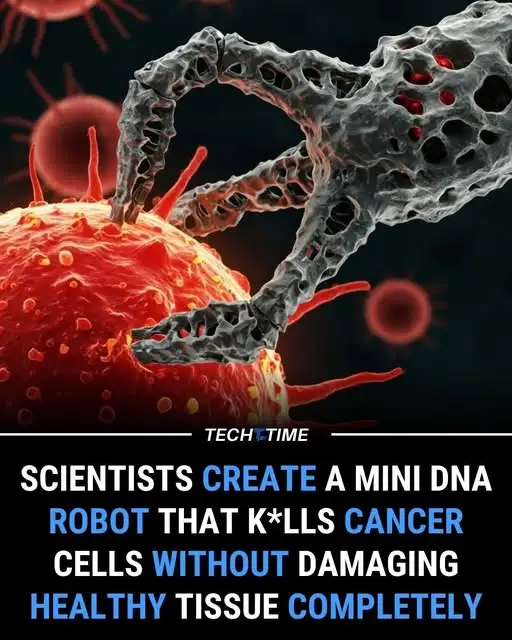
Microscopic DNA Robots: The Tiny Machines That Could End Cancer
Imagine a world where cancer treatment doesn’t leave you exhausted, nauseated, or weak. A world where therapy happens quietly inside your body — cell by cell — with no painful side effects, no collateral damage, and no long hospital stays. That world might not be as far away as you think.
In one of the most astonishing breakthroughs in modern medical science, researchers have created a microscopic DNA robot capable of finding and destroying cancer cells with surgical precision — while leaving healthy cells completely untouched.
The Rise of DNA Robots in Medicine
For decades, scientists have dreamed of using nanotechnology to fight disease at the molecular level. The idea sounded like science fiction: tiny machines traveling through the bloodstream, repairing damage and killing harmful cells. But now, with advances in DNA origami — the process of folding strands of DNA into complex shapes — that dream is becoming reality.
These DNA robots are not made of metal or plastic. Instead, they’re crafted from the same building blocks that make up life itself. Their design allows them to be programmable, meaning they can be trained to identify specific types of cells — including cancer cells — and act only when they find their target.
How the DNA Robot Works
When injected into the bloodstream, each DNA robot acts like a microscopic surgeon. It moves through blood vessels, scanning cells for the molecular “fingerprints” of cancer — special proteins that appear only on tumor surfaces.
Once a match is found, the robot springs into action. It opens its structure and releases a powerful treatment directly onto the cancer cell. In some designs, this treatment blocks the tumor’s blood supply, effectively starving it of oxygen and nutrients until it collapses.
In early lab tests, these nanobots have successfully destroyed cancerous tumors in mice, all while leaving surrounding healthy tissue completely unharmed — something no current cancer therapy can do.
Why This Breakthrough Matters
Traditional treatments like chemotherapy and radiation can save lives, but they also take a heavy toll. Because they attack rapidly dividing cells, they often damage hair follicles, digestive tissues, and immune cells. That’s why so many patients experience fatigue, hair loss, and nausea during treatment.
DNA robots, on the other hand, bring a new era of precision medicine. By working only at the microscopic level and targeting only diseased cells, they could eliminate tumors without harming the rest of the body.
This approach could revolutionize how we treat not only cancer, but potentially other complex diseases like Alzheimer’s, cardiovascular conditions, and autoimmune disorders — all by designing nanobots that deliver treatment precisely where it’s needed.
The Science Behind the Breakthrough
These tiny robots are made possible through a process called DNA origami. Scientists fold DNA strands into custom shapes that can open and close on command — like a tiny box with a molecular lock. The robot is “programmed” to recognize certain proteins that are unique to cancer cells. When it detects one, the box opens, releasing its cargo: either a drug, a signal molecule, or an enzyme that attacks the tumor.
It’s an elegant system that mimics nature’s precision. Instead of flooding the body with chemicals, it delivers treatment directly where it’s needed — nothing more, nothing less.
Testing and Early Results
In controlled studies, researchers at leading universities and biotechnology labs have tested these DNA nanobots in mice with solid tumors. The results have been nothing short of remarkable. Tumors shrank dramatically, survival rates increased, and — perhaps most importantly — there were no signs of damage to healthy tissues.
Dr. Kazuo Tanaka, a leading researcher in molecular nanotechnology, described it as “watching a surgeon work at the level of a single cell.”
While still in experimental stages, the technology’s potential has already sparked massive interest across the medical world.
The Future of Cancer Treatment
Experts believe that within the next decade, these DNA nanorobots could move from laboratory experiments to clinical trials in humans. The vision is to one day create a personalized army of microscopic machines — each one programmed to seek out and destroy specific types of cancer cells in a patient’s body.
Imagine a doctor prescribing not just a pill or an infusion, but an injection of programmable nanobots tailored to your DNA and your specific condition. They would travel through your veins, identify every trace of cancer, and shut it down from the inside out.
That’s not just medicine. That’s transformation.
Beyond Cancer: The Bigger Picture
While the focus is currently on cancer, researchers believe DNA robots could have countless other applications. They could deliver targeted therapies for genetic diseases, repair damaged neurons, clean up cholesterol deposits, or even reverse cellular aging in the future.
This is the beginning of a new era — where healing no longer relies solely on drugs and surgery, but on intelligent systems working within the body itself.
Challenges Ahead
Despite the excitement, there are still challenges to overcome. Scientists must ensure these DNA robots are safe, controllable, and effective in humans. They need to find ways to prevent immune reactions and make sure the nanobots degrade naturally once their job is done.
But if these hurdles can be cleared, the impact will be enormous. This technology could reshape the global healthcare system, offering safer, faster, and more affordable treatments for millions of patients worldwide.
A New Era of Healing
The creation of microscopic DNA robots isn’t just a scientific milestone — it’s a glimpse into the future of humanity’s relationship with disease. It shows that the battle against cancer doesn’t always have to be destructive. It can be smart, subtle, and beautifully precise.
One day soon, our bodies could host armies of invisible healers — DNA machines quietly fixing problems at the molecular level, protecting us from within.
The age of molecular medicine has begun.
Want to explore more on the future of biotechnology and medical breakthroughs? Stay tuned for more inspiring stories about how science is reshaping the limits of what’s possible.
