
Why Novelty Is the Real Anti-Aging Formula for Your Brain
Here’s a truth most people don’t realize: your brain doesn’t grow old — it just gets comfortable. And comfort, as it turns out, is the real enemy of growth.
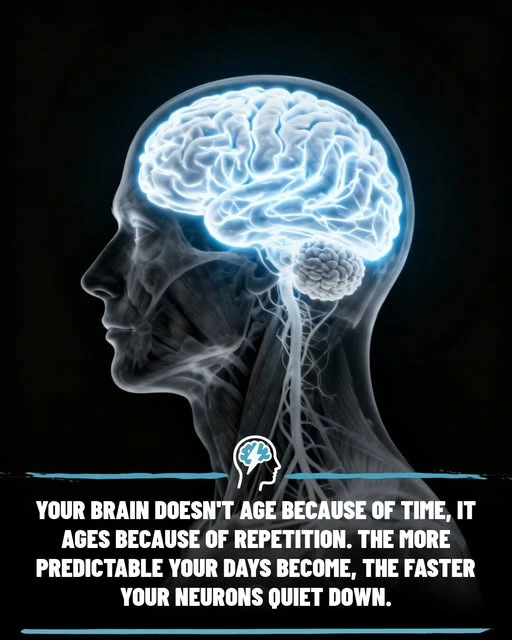
Your brain doesn’t decline with age — it declines with routine. When you stop learning, stop exploring, and stop challenging yourself, your brain quietly starts to power down. It’s not age that dulls the mind — it’s predictability.
The Hidden Danger of Routine
Routine feels safe. You wake up, check your phone, grab your coffee, drive the same route, and do the same work. But deep inside your brain, something fascinating — and slightly alarming — happens.
Each time you repeat the same habits, your brain fires the same neural circuits. These pathways become faster and more efficient, but also more rigid. This process is called synaptic pruning — the brain’s way of trimming unused connections and reinforcing the ones you use most.
It’s great for efficiency but terrible for adaptability. Over time, your brain becomes excellent at doing the same things — and worse at doing anything new.
Novelty: The Brain’s Natural Wake-Up Call
Here’s the antidote: novelty. Every time you experience something new — whether it’s learning a skill, traveling somewhere unfamiliar, or even taking a new route home — your brain lights up.
Novelty triggers the release of dopamine, the brain’s “pay attention” chemical. It tells your brain, “This matters. Remember this.” That spark of curiosity drives neuroplasticity — your brain’s ability to form new connections and reorganize itself throughout life.
Think of it like a mental workout. When you do something new, you’re forcing your brain out of autopilot and into growth mode.
Neuroplasticity: Your Brain’s Superpower
Neuroplasticity is what allows your brain to adapt, learn, and recover. It’s the reason stroke patients can relearn how to walk. It’s the reason you can pick up a new language, hobby, or career even in your 50s or 60s.
For years, scientists believed the brain’s growth stopped after childhood. But modern research has proven otherwise. Even aging brains can rewire themselves and even generate new neurons — a process called neurogenesis — especially when exposed to novelty, complexity, or challenge.
The Real Cause of Mental Decline
It’s not time that dulls the brain — it’s repetition. Doing the same thing over and over conserves energy, but it also signals to your brain that there’s no need to grow. You stop releasing dopamine, and those circuits that once thrived on learning start to fade.
In other words, your brain isn’t getting older — it’s just bored.
So if you’ve ever felt mentally foggy, uninspired, or “stuck,” it might not be fatigue — it might be routine slowly turning off your brain’s curiosity switch.
How to Reignite Your Brain Through Novelty
The good news? You can flip that switch back on — starting today. Here are some science-backed ways to bring novelty and challenge back into your life:
- Learn something new: Pick up a language, an instrument, or a creative skill like painting or coding. The unfamiliar process keeps your neurons firing.
- Change your environment: Rearrange your workspace, explore a new café, or travel to an unfamiliar city. New surroundings stimulate your sensory systems.
- Challenge your routine: Take a different route to work, use your non-dominant hand, or try a new recipe without a guide.
- Engage in meaningful conversations: Talking to people outside your usual circle introduces new ideas and perspectives.
- Move your body differently: Activities like dancing, yoga, or martial arts connect physical coordination with mental flexibility.
Each new experience, no matter how small, sparks dopamine and signals your brain to adapt. The more you do it, the younger and sharper your mind becomes.
Why Dopamine Matters
Dopamine isn’t just about pleasure — it’s about motivation. When something feels new or exciting, dopamine tells your brain, “This is worth learning.” That’s why novelty is so powerful for learning, memory, and creativity.
In contrast, too much predictability lowers dopamine levels, making you feel unmotivated, uninspired, and stuck in a mental loop. Novelty acts as a natural reset button, reigniting focus and curiosity.
The Link Between Novelty and Longevity
Studies show that people who continue learning new skills into old age maintain stronger memory, faster processing speed, and lower risks of cognitive decline. Researchers at Harvard even found that adults who engage in mentally challenging activities reduce their risk of Alzheimer’s and dementia.
Simply put, novelty is your brain’s real anti-aging formula. It keeps your neural pathways active, flexible, and ready to adapt — no matter your age.
Small Changes, Big Impact
You don’t need to move to another country or start skydiving to keep your brain young. The power lies in small, consistent challenges. Try cooking a dish from another culture. Read a book outside your usual genre. Take an online class that intimidates you a little.
Every time you step outside your comfort zone, your brain thanks you by growing stronger.
Final Thoughts: Don’t Let Your Brain Go on Autopilot
Autopilot is comfortable, but it’s also where creativity dies. The next time you catch yourself repeating the same routines, ask: When was the last time I did something for the first time?
Remember, your brain isn’t aging — it’s adapting to what you feed it. Challenge it, surprise it, and stretch it. Because the moment you stop seeking new experiences is the moment your mind starts to fade.
So break the pattern. Learn, explore, create — and keep your brain young for life.
Novelty isn’t just fun — it’s survival for your mind.
