
: A Rabbit in the Sky
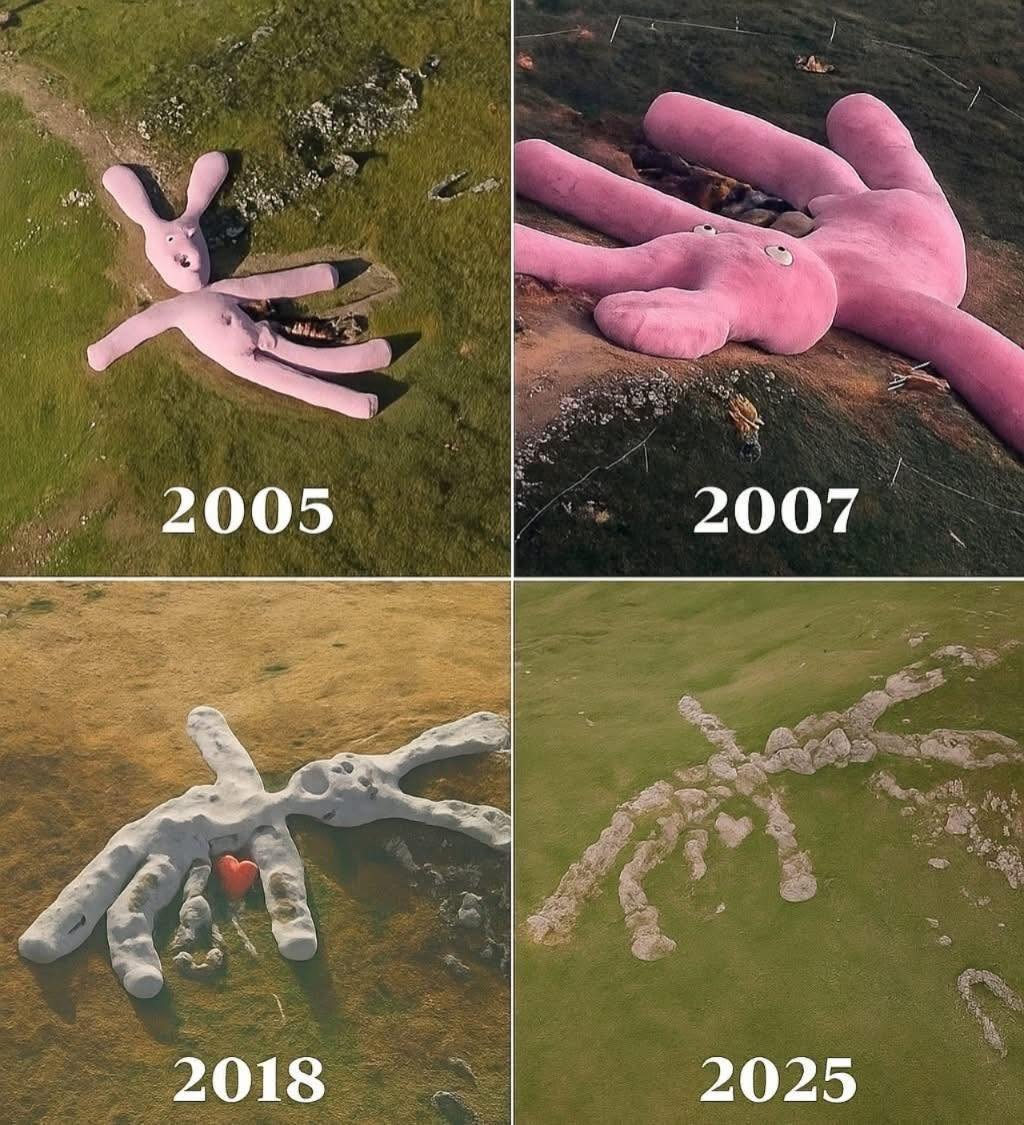
In the green, rolling hills of Colletto Fava, in Piedmont, northern Italy, something surreal once appeared — an enormous, bubble-gum-pink rabbit lying peacefully across the landscape. Measuring over 60 meters (200 feet) long and 6 meters high, the creature looked as if a child’s toy had fallen from the heavens and come to rest among the mountains. It wasn’t a prank, nor a movie prop, but a monumental work of contemporary art called Hase (German for “hare”), created in 2005 by the Austrian art collective Gelitin.
The sight was so unexpected, so absurd, that it made visitors laugh, gasp, and climb all over it. Yet behind the humor was something deeper — a meditation on childhood, decay, and the passage of time itself.
The Birth of an Unlikely Giant
Gelitin — composed of four Austrian artists (Wolfgang Gantner, Florian Reither, Tobias Urban, and Ali Janka) — had long been known for their provocative, playful installations. They specialized in art that invited direct participation: messy, interactive, and sometimes outrageous. For Hase, they wanted to create something that would bring people joy while simultaneously confronting them with the inevitability of aging and deterioration.
Built over five years in the Italian Alps, Hase was hand-woven from coarse, waterproof pink fabric and stuffed with nearly 200,000 pounds of straw. From above, it resembled a toy bunny dropped onto the hillside, one arm flung outward, eyes stitched with black crosses, its mouth slightly open in a frozen, whimsical grimace.
To Gelitin, this was not merely a sculpture — it was a living experience. Visitors were encouraged to climb, sit, sleep, and picnic on the giant rabbit. Unlike traditional artworks protected by glass or velvet ropes, Hase was meant to be touched, trampled, and loved until it eventually fell apart.
A Toy for Giants — and for Children at Heart
The artists described Hase as a “gift to the people of the mountains.” They imagined hikers stumbling upon it unexpectedly, seeing its bright pink bulk sprawled across the natural greens and browns of the Alpine meadow. From a distance, it looked like a surreal mirage — a child’s fantasy made real.
The idea of scale was central. To humans, Hase appeared as a toy meant for giants — yet to the mountain itself, it was small and temporary, just another object that would one day vanish. Gelitin’s goal was to reverse our perspective: to make adults feel childlike again, dwarfed by the wonder of something playful and enormous.
The rabbit’s soft material and relaxed posture invited physical interaction. People hugged its limbs, took naps on its belly, and left messages stitched into its pink fabric. Children climbed it like a playground; couples posed for wedding photos beside its floppy ears.
Through this intimacy, Hase blurred the line between art and life, reminding us that joy, too, can be a profound artistic experience.
Time as the True Artist
From the beginning, Gelitin planned for Hase to decompose naturally. They predicted that it would take about 20 years for the rabbit to completely disintegrate — a built-in collaboration between human creation and nature’s quiet erasure.
The artwork’s slow decay became part of its meaning. As seasons passed, the weather began to gnaw at the fabric. Snow flattened its limbs, rain faded its color, and animals burrowed into its straw belly. By 2016, only remnants of its pink skin and metal skeleton were visible, and by the 2020s, nature had reclaimed nearly everything.
What remained was a ghost of joy, an empty hillside where laughter once echoed. But that emptiness carried a new message: even the most monumental creations are temporary. In this way, Hase became a poetic reflection on mortality — a giant symbol of impermanence resting quietly in the grass.
Art That You Can Climb On
Hase was not just visual art; it was an experience that unfolded through touch, scale, and time. Gelitin deliberately rejected the elitism often associated with modern art museums. You didn’t need an art degree to “understand” Hase. You just needed to see it, laugh, and maybe climb it.
In that sense, the work was radically democratic. It treated viewers not as spectators, but as participants. The artists even described it as an “interactive monument to happiness.” Children saw a giant stuffed toy; adults saw nostalgia made physical; art critics saw a subversion of traditional sculpture. All were correct.
Symbolism: Between Play and Decay
Beneath its humor, Hase carried layers of symbolism. The rabbit — a creature associated with innocence, fertility, and rebirth — became a stand-in for the human condition. Its bright color symbolized the vibrancy of youth, while its planned decay represented the inevitability of aging and loss.
Even its expression, with eyes stitched like X’s, hinted at mortality. Yet the figure’s relaxed posture and peaceful sprawl suggested acceptance — not tragedy, but a gentle surrender to time.
The contrast between the soft pink fabric and the rugged Alpine landscape created a dialogue between nature and culture, fragility and permanence, absurdity and beauty.
The Legacy of a Vanishing Giant
Although Hase physically disappeared, its image continues to live online and in art history discussions. Satellite photos once showed the rabbit clearly from space — a pink figure lying in the Italian hills. Today, those same coordinates on Google Earth show only grass and shadows, but the ghostly outline of Hase still appears faintly, like a memory.
Tourists still visit Colletto Fava, not to see the rabbit itself, but to stand where it once lay. Locals sometimes describe the site as having a strange serenity, as if the mountain remembers its pink visitor.
In the broader art world, Hase inspired discussions about ephemeral art — works meant to decay, vanish, or exist only temporarily. Similar in spirit to Christo and Jeanne-Claude’s environmental wrappings or Andy Goldsworthy’s nature sculptures, Hase challenges the idea that art must last to have meaning.
By embracing its own destruction, it achieved something permanent in another way: emotional permanence. Those who saw it remember the joy, absurdity, and fleeting beauty of that giant pink rabbit lying beneath the clouds.
A Reminder That Nothing Lasts Forever
What remains of Hase today is not the fabric or straw, but the feeling it created — a sense of wonder that something so massive could also be so tender. It stands (or rather, once lay) as a gentle reminder that time spares nothing: not youth, not love, not art.
Yet within that truth lies comfort. Just as Hase slowly merged back into the landscape, we, too, return to the earth. Art, in this view, is not about resisting decay but about celebrating existence while it lasts.
Conclusion: When Play Becomes Philosophy
In the end, Hase was never just a sculpture. It was a story — one of creation, laughter, and disappearance. It made the world feel both small and infinite, both silly and profound. It reminded us that art can be playful without losing meaning, and that nature always has the final brushstroke.
On the slopes of Colletto Fava, the grass now grows where the rabbit once smiled. But perhaps that’s how it was always meant to be: a monument that vanishes, leaving behind not marble or metal, but a whisper — that joy, like all things, is beautiful precisely because it doesn’t last forever.
