
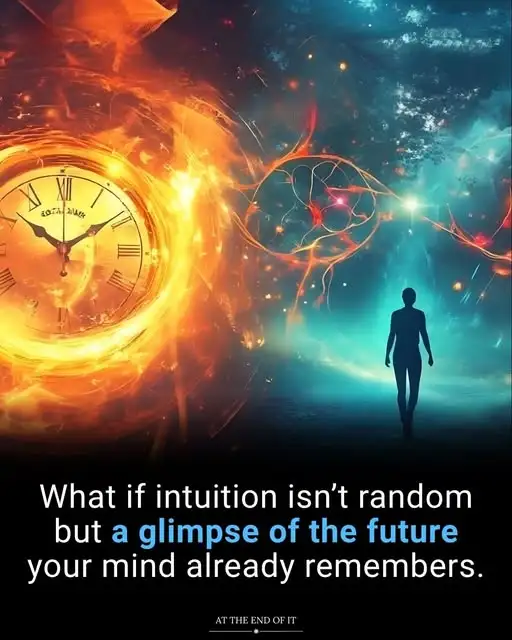
Is Intuition a Glimpse of the Future? The Science Behind “Knowing Before It Happens”
Have you ever had a strong feeling that something was about to happen — and then it did? Maybe you thought of a friend moments before they called. Or you avoided a route for no clear reason, only to learn later there was an accident there. We call it “intuition,” but what if this mysterious sense is something deeper — something that bends time itself?
What Scientists Are Discovering About Intuition
For decades, intuition was dismissed as mere instinct or coincidence. But new research is challenging that view. Studies from HeartMath Institute and the Institute of Noetic Sciences reveal that the human body might actually respond to future events — seconds before they occur.
In carefully controlled experiments, scientists found that both the brain and heart showed measurable changes in rhythm and electrical activity before participants were shown random images — pleasant or disturbing — that they couldn’t possibly predict. This phenomenon, sometimes called “presentiment”, suggests that our awareness might stretch beyond the present moment.
Memory Reaching Forward in Time?
Some researchers describe intuition as “memory reaching forward in time.” In other words, what we feel as a gut instinct could actually be our subconscious recognizing patterns or information from the future — just as it recalls things from the past.
This sounds almost poetic, but it’s grounded in fascinating neuroscience. The brain is constantly scanning for patterns, drawing from countless experiences. Sometimes, it pieces things together before our conscious mind catches up. But in these studies, the reactions came too soon — occurring before any stimulus appeared. That’s what’s making scientists reconsider what intuition really is.
How the Heart Plays a Role
We often say, “follow your heart.” Science may be showing us that this isn’t just a metaphor. The HeartMath Institute has discovered that the heart sends more signals to the brain than the brain sends to the heart. During intuitive moments, the heart’s rhythm changes — as if it senses information before the brain does.
When people were connected to heart-rate monitors, their hearts seemed to anticipate emotional images that hadn’t yet been displayed. These subtle shifts happened seconds in advance, almost as if the heart was aware of what was coming next. It’s one of the strongest pieces of evidence suggesting that human intuition might extend beyond time.
Quantum Connection: Consciousness Beyond the Physical
Now, here’s where things get even more mind-bending. Physicists have long known about quantum entanglement — a phenomenon where two particles become linked, no matter how far apart they are. When something affects one particle, the other reacts instantly, even across vast distances.
Some scientists propose that consciousness could operate in a similar way — connected across space and time. If our awareness is part of a vast, interconnected field, it might explain why we occasionally sense events before they happen. It’s not “magic,” but rather a deeper property of how information and energy interact in the universe.
What This Means for Everyday Life
We’ve all had moments when logic fails but intuition saves the day. You feel something is “off” about a situation. You sense danger before it becomes obvious. Or you get an inner nudge to reach out to someone — just when they need it most.
Instead of brushing these experiences aside, research now suggests they may be worth paying attention to. The more you trust and develop your intuition, the more attuned your brain and heart become to subtle signals — from both within and beyond.
How to Strengthen Your Intuitive Awareness
While science is still exploring how intuition works, there are practical ways to cultivate it:
- Quiet the mind: Meditation or deep breathing helps calm analytical thought, allowing intuitive insight to surface.
- Listen to your body: Your gut reactions and heart rhythms can carry information your brain hasn’t yet processed.
- Keep an intuition journal: Write down moments when your instincts proved right. Over time, patterns may emerge.
- Trust small nudges: The more you act on intuitive feelings, the more accurate they tend to become.
Developing intuition doesn’t mean ignoring logic. It’s about balancing reason with awareness — tuning into information that your senses might not yet fully perceive.
The Future of Intuition Research
Institutions like HeartMath and the Institute of Noetic Sciences continue to explore the boundaries of human consciousness. With advances in neuroscience and quantum physics, the idea that the mind transcends time is gaining serious attention. Publications such as Nature Human Behaviour and Scientific American have begun covering these discoveries, hinting that intuition might not be mystical after all — just misunderstood.
Final Thoughts: Intuition as a Bridge Between Mind and Universe
Maybe intuition isn’t about “guessing” the future — but rather, remembering it early. If consciousness truly exists in a timeless field, then intuition could be our natural connection to that vast intelligence that links every thought, every moment, every life.
So the next time your gut speaks, pause and listen. Science is beginning to show that your instincts might not only come from experience — they could be whispers from the future.
Sources: HeartMath Institute, Institute of Noetic Sciences, Nature Human Behaviour, Scientific American, National Geographic
