
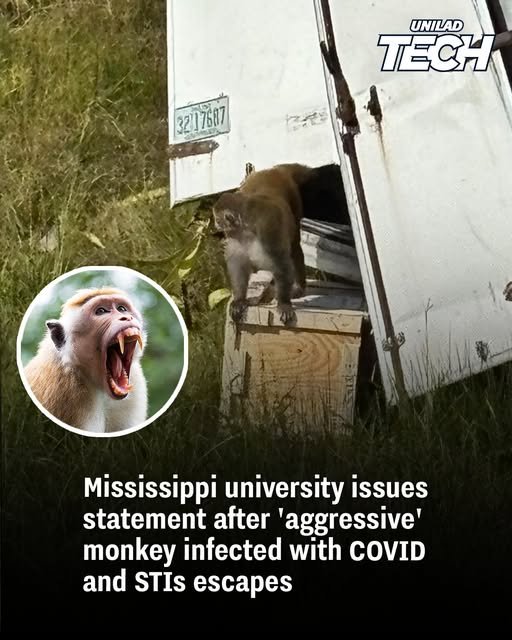
🐒 Mississippi on Edge After “Aggressive Monkey” Escape Sparks Panic — Tulane University Sets the Record Straight
🚨 A Shocking Report Sends Mississippi Into Panic
Residents across Mississippi woke up to a terrifying alert this week — a warning from local authorities that an “aggressive monkey infected with COVID and STDs” was on the loose after a truck accident in Jasper County.
The alarming message came from the Jasper County Sheriff’s Department, which shared a post on Facebook describing a chaotic scene: a truck carrying several Rhesus monkeys had overturned, and some of the animals had escaped.
“This was a truck carrying Rhesus monkeys from Tulane University,” the statement read. “The monkeys are approximately 40 lbs, they are aggressive to humans and they require PPE to handle.”
That wasn’t all — the post went further, stating that the monkeys were carriers of hepatitis C, herpes, and COVID-19, and warning residents to stay away at all costs.
For a few tense hours, social media was flooded with memes, frantic warnings, and worried comments from locals. Some residents claimed to have seen “something moving in the woods,” while others begged authorities to confirm if the animals were truly infected.
💥 Viral Panic and Wild Theories
The Sheriff’s Department’s post quickly went viral — gaining thousands of shares and sparking debate nationwide. Many assumed the escaped animals had been used in laboratory experiments, and that their exposure to infectious diseases made them a potential biohazard.
Others speculated that the monkeys had been part of COVID-related vaccine trials or medical testing for sexually transmitted infections — both of which Tulane University researchers have studied in the past.
The tone of panic was amplified by the phrasing in the sheriff’s post, which mentioned that “all but one of the escaped monkeys have been destroyed.”
But as the story spread across social media and international headlines began calling it “the Mississippi Monkey Outbreak,” Tulane University officials were quick to step in with the facts.
🧪 Tulane University Responds: “The Rumors Are False”
Representatives from Tulane University — one of the most respected biomedical research institutions in the United States — publicly denied that the escaped animals were infected or even part of their program.
Michael Strecker, a Tulane spokesperson, clarified to NOLA.com and other media outlets that the information shared by law enforcement was “incorrect and misleading.”
“The primates in question belong to another entity and are not infectious,” Strecker said. “They had not been exposed to any infectious agent.”
He added that Tulane’s National Biomedical Research Center maintains strict safety and biosecurity measures and that none of its animals are released or transported without meeting federal health standards.
Another university spokesperson echoed Strecker’s statement, explaining that while Tulane does occasionally supply primates for external research partnerships, those animals are healthy and disease-free when transported.
“We are actively collaborating with local authorities,” Tulane’s statement read. “A team of animal care experts has been offered to assist with locating and recovering the missing animal safely.”
🧍♂️ So Where Did the Misinformation Come From?
According to an updated release from the Jasper County Sheriff’s Department, the truck driver involved in the crash was the source of the initial claims.
“The driver told local law enforcement that the monkeys were dangerous and posed a threat to humans,” the department said. “He also stated that PPE was required to handle them.”
Based on that testimony — and lacking immediate information from the research entities involved — officers acted out of caution. Their Facebook post, however, spread before verification was complete.
When Tulane’s clarification surfaced, the department acknowledged the mix-up, saying they were “acting on the information provided at the scene.”
🐒 What Happened to the Escaped Monkeys?
Officials confirmed that most of the monkeys were captured or euthanized shortly after the crash, but one monkey remains unaccounted for.
While the missing primate is not infected or dangerous in a biological sense, experts warn that it could still pose a physical risk to humans if approached.
“A 40-pound Rhesus macaque is strong and unpredictable,” one wildlife specialist noted. “Even healthy monkeys can bite or scratch if they feel threatened.”
Residents in Jasper County have been advised not to attempt to capture or feed the animal and to report any sightings to local authorities immediately.
🧠 What This Incident Reveals About Public Panic
This strange story serves as a modern reminder of how fast misinformation spreads — especially when it involves health threats.
Within hours of the Sheriff’s initial post, conspiracy theories and panic posts flooded social media. Some users compared the situation to “a real-life Planet of the Apes,” while others feared an “infected animal outbreak.”
Experts in public communication say it’s a textbook case of how misinterpreted data + social media = viral fear.
“People are more likely to share alarming information before verifying it,” said one media analyst. “And when it involves COVID or animals, fear spreads instantly.”
Tulane’s immediate clarification helped calm the situation, but the university also emphasized how damaging false information can be to public trust — and to legitimate scientific research.
⚠️ Why the Story Struck a Nerve
Several factors made this story explode online:
- Pandemic Anxiety: COVID-19 fears remain deeply ingrained, so any mention of “infected animals” triggers mass concern.
- Viral Imagery: The idea of monkeys escaping from a lab has cinematic appeal, fueling shares and speculation.
- Conflicting Statements: When two official sources — police and a university — give different messages, confusion escalates fast.
Even after Tulane’s correction, screenshots of the original Facebook post continued to circulate with misleading captions.
🏛️ What Happens Next
As of Wednesday, Tulane University says it continues to assist in tracking the final missing monkey and that no infections or injuries have been reported.
The Jasper County Sheriff’s Department has updated its post, urging residents to avoid spreading unverified information and confirming that the animals pose no public health risk.
Meanwhile, animal welfare advocates have called for a review of how live research animals are transported, emphasizing better containment and clearer communication protocols in emergencies.
💡 The Bigger Lesson
The Mississippi monkey incident is more than just an odd viral headline — it’s a case study in misinformation and modern panic.
What began as a simple truck accident quickly spiraled into national hysteria fueled by fear, social media, and half-truths.
Tulane’s transparency, paired with corrections from local law enforcement, ultimately restored order — but not before the story gained millions of views worldwide.
