
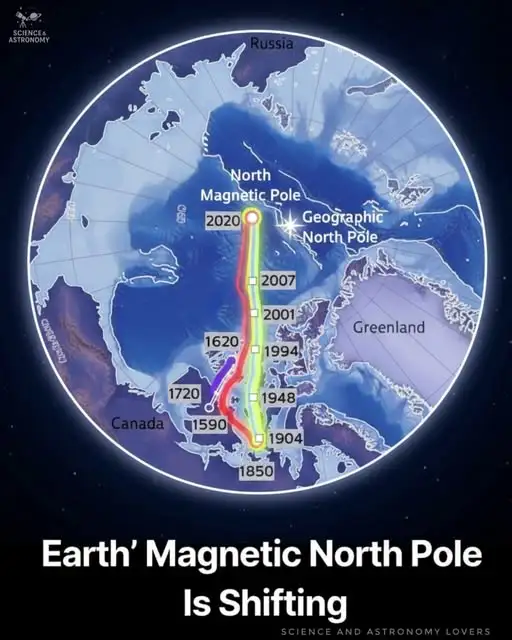
Earth’s Magnetic Heart Is on the Move — And It’s Speeding Up!
Imagine the invisible heart of our planet — a massive, molten engine churning thousands of kilometers beneath your feet — shifting its rhythm. For over 400 years, Earth’s North Magnetic Pole has wandered across the Arctic, but in recent decades, it’s started to race like never before. What’s happening deep inside our planet is nothing short of extraordinary.
A Magnetic Mystery Beneath Our Feet
Our planet’s magnetic field is what makes compasses point north. It’s what protects us from harmful solar radiation and helps birds, whales, and even bacteria navigate. But this invisible shield isn’t static — it’s alive, in constant motion, shaped by the swirling iron currents of Earth’s molten core.
Scientists have known for centuries that the magnetic poles move. But something changed in the late 20th century. The North Magnetic Pole, once inching along at a leisurely pace, suddenly began to accelerate — speeding from around 10 kilometers per year to over 50 kilometers annually. Today, it’s racing toward Siberia at a pace that continues to puzzle geophysicists.
What’s Causing the Shift?
Deep beneath Earth’s crust lies a turbulent ocean of molten iron and nickel — a superheated metallic core generating powerful electric currents. These currents create the magnetic field that surrounds our planet, known as the geomagnetic field.
Think of it like a cosmic dynamo: as molten metal moves, it produces magnetism. Changes in that movement — especially in the outer core — can alter the direction and strength of the magnetic field. Scientists believe powerful flows of liquid iron beneath northern Canada and Siberia are tugging the magnetic field lines, shifting the magnetic pole’s position over time.
The Core Connection
Recent satellite data from missions like the European Space Agency’s Swarm project reveal that these iron flows are not constant. They can speed up, slow down, and even reverse direction — like massive underground rivers. These shifts appear to coincide with the pole’s acceleration, suggesting a direct link between Earth’s core dynamics and the pole’s unpredictable journey.
From Compass to GPS: Why It Matters
You might wonder — does this really affect us? The short answer: yes.
Our navigation systems, from traditional compasses to high-tech satellites, rely on accurate magnetic data. Every few years, scientists update the World Magnetic Model (WMM) — a global map of Earth’s magnetic field used by everything from your smartphone’s map app to military navigation systems.
In 2019, the pole’s rapid movement forced an unscheduled update to the model, years ahead of plan. That’s how fast things are changing.
Even wildlife feels the effects. Many animals — like sea turtles, salmon, and migratory birds — use Earth’s magnetic field to guide them. As the field shifts, scientists are studying how these species adapt to the moving magnetic “map” they instinctively follow.
Could the Poles Flip?
One of the most intriguing — and often misunderstood — questions about Earth’s magnetic field is whether it could flip entirely.
Yes, it has happened before. Geological evidence shows that magnetic pole reversals occur every few hundred thousand years. During a reversal, the north and south magnetic poles swap places. The last major reversal happened about 780,000 years ago, and some data suggest we may be slowly heading toward another one.
But don’t panic — it wouldn’t happen overnight. A full reversal takes thousands of years, and while it could temporarily weaken our planet’s magnetic shield, scientists don’t expect catastrophic effects. Still, it’s a powerful reminder that even something as “steady” as north is part of a much bigger, evolving system.
Earth’s Magnetic Field: A Living Shield
Earth’s magnetic field is our silent guardian. It deflects solar winds and cosmic radiation, shaping the spectacular auroras that dance across polar skies. Without it, our atmosphere would erode over time, leaving Earth vulnerable — much like Mars, which lost most of its magnetic field billions of years ago.
So when scientists say the magnetic pole is moving faster, they’re not just talking about a change in compass readings. They’re describing deep transformations in the planet’s inner life — the kind of slow-motion drama that shapes worlds.
Listening to the Planet’s Pulse
Researchers are now using supercomputers and satellite networks to model these core dynamics in unprecedented detail. Each new discovery adds a piece to the puzzle — how the molten core moves, how that movement reshapes the magnetic field, and what it all means for the future.
In a sense, we’re learning to “listen” to Earth’s magnetic heartbeat. Every fluctuation tells a story about the fiery ocean below — a world we can’t see, but one that touches every compass, every GPS signal, every aurora-filled sky.
What the Future Holds
For now, the North Magnetic Pole continues its journey toward Siberia, with no signs of slowing down. Scientists will keep tracking its path, updating global navigation systems, and deepening our understanding of how our planet truly works from the inside out.
And perhaps that’s the beauty of it all — the reminder that Earth is not static. It’s alive, restless, and full of mysteries still unfolding beneath our feet.
Final Thoughts
As we gaze at our compasses or navigate by GPS, we’re connected to a story billions of years in the making — a story of iron rivers, shifting poles, and an ever-beating magnetic heart. The next time you see the aurora flicker or watch your compass needle twitch, remember: the Earth beneath you is in motion, whispering its secrets through magnetism and time.
#EarthScience #GeomagneticField #NorthMagneticPole #PlanetEarth #ScienceExplained
