
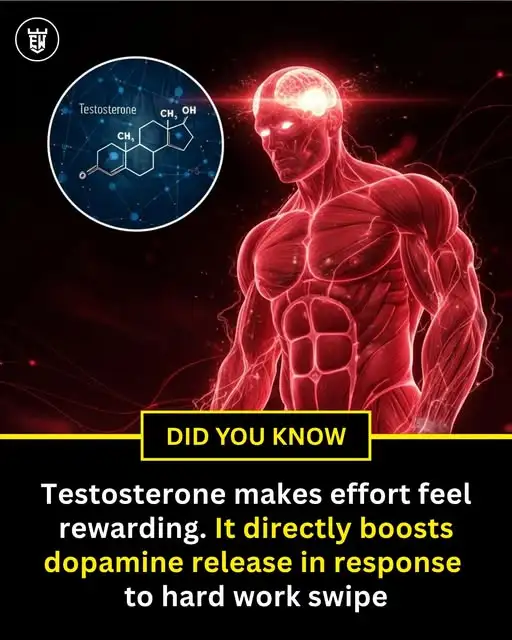
The Hidden Chemistry of Motivation: How Testosterone Turns Hard Work into Pleasure
Why do some people thrive on challenge while others feel drained by it? Why does one person light up when chasing goals, while another struggles to find motivation? It turns out the secret may lie deep in our brain chemistry — and one powerful hormone plays a starring role.
Recent research reveals that testosterone doesn’t just influence muscle growth or confidence — it directly shapes how the brain experiences effort and reward. In short: testosterone can make hard work feel good.
When Effort Feels Like Reward
Scientists studying the neurological effects of testosterone found something remarkable. During challenging tasks that require focus, persistence, and exertion — both mental and physical — individuals with higher testosterone levels showed stronger dopamine activity.
Dopamine, often called the brain’s “reward chemical,” is released when we achieve something meaningful. It’s what makes victory taste sweet and progress addictive. But testosterone appears to amplify that response — making the act of striving itself pleasurable, not just the outcome.
In other words, effort becomes its own reward. The brain learns to associate hard work with satisfaction, persistence with pleasure, and challenge with motivation. This might explain why some people seem to “enjoy the grind” — their biology literally rewards them for it.
Testosterone and Dopamine: A Powerful Duo
To understand how this works, we need to look at the brain’s motivation circuitry. Dopamine is produced in areas like the ventral tegmental area and travels to regions responsible for focus, reward, and learning — including the prefrontal cortex and nucleus accumbens.
Testosterone interacts with this system, enhancing dopamine’s impact and increasing sensitivity to reward cues. When testosterone levels rise, so does the brain’s ability to feel pleasure from pursuing goals or overcoming obstacles.
This connection isn’t just about feeling good — it’s about reinforcing behavior. Every time effort triggers a dopamine release, the brain learns that persistence pays off. Over time, that feedback loop can strengthen motivation, productivity, and resilience.
Motivation Isn’t Just Mindset — It’s Chemistry
We often think of motivation as a matter of willpower or discipline. But biology plays a huge role. Hormones like testosterone help determine how rewarding we perceive effort to be — and how much pleasure we get from progress.
That doesn’t mean people with lower testosterone can’t be motivated. Rather, it highlights how biology and behavior intertwine. Environment, sleep, stress, nutrition, and exercise all influence hormonal balance — and in turn, how driven or satisfied we feel by our goals.
The Effort–Reward Feedback Loop
Here’s the fascinating part: dopamine isn’t only released when we achieve something. It’s released in anticipation — when we strive, when we push, when we believe we’re getting closer. Testosterone strengthens that anticipation, turning effort into excitement rather than frustration.
This is the chemistry behind phrases like “runner’s high” or “the thrill of the chase.” The body and brain create a self-sustaining loop — where action fuels pleasure, and pleasure fuels more action.
From the Gym to the Office: Everyday Impacts
This science doesn’t just apply to athletes or fitness enthusiasts. It extends to creativity, work, education, and personal growth. Whether you’re solving a tough problem, learning a new skill, or running your first marathon, your hormonal state influences how rewarding that process feels.
That’s why people with balanced or optimized testosterone levels often report higher drive, sharper focus, and a deeper sense of satisfaction in achievement. When your internal chemistry supports effort, you’re more likely to enjoy the process — not just the results.
Implications Beyond Motivation
The implications of this discovery go beyond personal performance. Scientists suggest that understanding the link between testosterone and dopamine could help address motivation deficits, burnout, and certain mental health conditions like depression or ADHD — where dopamine signaling is disrupted.
By tuning the brain’s reward system, it might be possible to help people rediscover the natural pleasure of effort — the joy of striving toward something meaningful.
Can You Boost This Effect Naturally?
Yes — to some extent. Testosterone and dopamine are deeply interconnected, and both respond to lifestyle habits. Here are a few evidence-based ways to naturally support this system:
- Exercise regularly: Resistance training and high-intensity workouts can increase testosterone and dopamine activity.
- Get quality sleep: Sleep deprivation reduces testosterone and blunts dopamine sensitivity.
- Manage stress: Chronic stress raises cortisol, which suppresses both testosterone and motivation.
- Eat well: Diets rich in healthy fats, zinc, magnesium, and vitamin D support hormone health.
- Challenge yourself: Taking on small, meaningful challenges trains your brain to link effort with reward.
It’s a virtuous cycle — the more you engage in activities that elevate testosterone and dopamine, the more your brain rewards you for doing them.
The Science of Feeling Accomplished
At its core, this discovery reshapes how we think about success and satisfaction. Motivation isn’t just psychological — it’s biochemical. And understanding that connection gives us new tools to work with, rather than against, our own biology.
When testosterone amplifies dopamine, hard work stops being a burden. It becomes a source of pleasure, even pride. Every obstacle turns into an opportunity for your brain to celebrate progress — a chemical “high” that drives growth, learning, and achievement.
Final Thoughts
So the next time you push through a tough project, power through a workout, or keep going when it gets hard, remember — your brain is rewarding you in ways you can’t even see. It’s not just grit. It’s chemistry.
Motivation isn’t magic — it’s biology in motion. And by understanding how hormones like testosterone fine-tune our dopamine systems, we gain not just insight into what drives us, but also the power to nurture it.
#BrainScience #MotivationBoost #DopamineRewards #ExplainingTheWorld #SmartFeed
