
Japanese Crows Are Outsmarting Traffic Lights — And Humans Are Amazed
Imagine standing at a crosswalk in Japan and noticing a crow swoop down just as the light turns red. It lands, grabs a cracked walnut from the pavement, and flies off before the cars move again. Coincidence? Not quite.
What you’ve just witnessed is one of nature’s most fascinating examples of animal intelligence — crows using city traffic to crack open walnuts. This isn’t random behavior. It’s calculated, consistent, and downright genius.
Let’s explore how Japan’s crows are mastering urban life, why scientists are so intrigued, and what this behavior tells us about intelligence in the animal kingdom.
The Clever Trick: Letting Cars Do the Hard Work
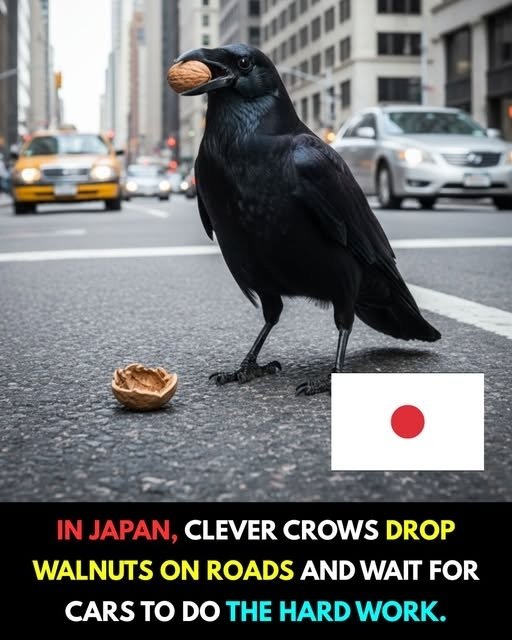
In several Japanese cities, researchers have observed crows picking up hard-shelled walnuts — a favorite food — and flying to intersections. Instead of struggling to break them open with their beaks, the crows simply drop the nuts onto busy roads.
When the light turns green, cars drive over the walnuts, cracking the shells open effortlessly. Then, when the light switches to red and traffic stops, the crows swoop down to enjoy the reward. It’s like watching a perfectly timed heist — except the thieves have feathers and flawless timing.
This behavior has been documented by scientists and bird watchers for years, and it continues to evolve. The crows seem to understand not only how traffic works but also when it’s safe to retrieve their food.
Understanding the “Traffic Game”
Researchers studying this phenomenon noticed that the birds don’t act randomly. They appear to grasp the rhythm of traffic lights, associating green with danger and red with safety. This suggests an advanced level of learning and adaptation — a sign of true intelligence.
Some crows even take things further. Instead of dropping the walnut directly into traffic, they’ll place it at crosswalks where cars are more likely to slow down and people walk afterward. When pedestrians cross, they might accidentally step on or move the nut, making it easier for the crow to access the kernel. Talk about using teamwork — without even asking!
What Makes Crows So Smart?
It’s no secret that crows are among the most intelligent animals on Earth. Studies have shown that they can use tools, solve puzzles, and even recognize human faces. But the Japanese crow traffic trick might be one of their most impressive feats yet.
Here’s why it stands out:
- Planning and patience: The crow waits for the right moment — it doesn’t just drop the nut and hope for luck.
- Understanding cause and effect: It knows that cars will crush the nut and that the light cycle offers a safe retrieval window.
- Learning from humans: The crow has adapted to an entirely human-made system — traffic lights, cars, and urban timing.
This combination of learning, adapting, and planning behavior puts crows in a rare category of non-human animals capable of complex reasoning.
The Science Behind the Behavior
The behavior of Japan’s crows was first studied extensively by Dr. Masakazu Nihei and Dr. Yutaka Watanabe, two researchers who observed these birds in Sendai, Japan. They found that the crows didn’t just rely on instinct — they actively adjusted their behavior based on traffic flow and timing.
For example, when traffic density changed, the crows changed their dropping height or the timing of when they approached the intersection. This indicates situational awareness and learning through experience — much like how humans improve at tasks over time.
Other studies have shown that crows can remember human faces for years, pass knowledge to younger generations, and use multiple tools in sequence to solve problems — something once thought to be unique to primates.
Cultural Respect for Crows in Japan
In Japan, crows (known as karasu) hold a unique place in culture and mythology. While some see them as pests, others view them as symbols of intelligence and adaptability. Their ability to thrive in crowded cities like Tokyo or Osaka reflects a level of coexistence with humans that few wild animals achieve.
Urban planners and scientists alike are fascinated by how these birds navigate human environments with ease. They understand trash collection schedules, use vending machines, and even remember which streets yield the best food opportunities.
So when we see crows dropping walnuts at intersections, we’re not just watching survival — we’re witnessing the brilliance of adaptation in real time.
Why This Matters: Rethinking Animal Intelligence
For decades, humans assumed that only primates — and maybe dolphins — were capable of true problem-solving. But the more we study birds like crows, the more that assumption crumbles.
The Japanese walnut-dropping crows show us that intelligence isn’t defined by brain size but by the ability to learn, adapt, and plan. These birds observe, experiment, and even teach — behaviors that challenge our very definition of what it means to be “smart.”
As Dr. Watanabe once said, “They are not just reacting — they are thinking.”
What We Can Learn from the Crows
There’s a quiet beauty in how these birds interact with the world. Instead of fighting against their environment, they learn from it. They don’t see human systems as obstacles — they see them as opportunities.
And maybe that’s the lesson for us all. Intelligence isn’t just about IQ or instinct. It’s about observation, patience, and adaptation. It’s about seeing the world differently and using it creatively to thrive.
So next time you’re waiting at a red light and spot a crow nearby, watch closely. You might just be witnessing one of nature’s smartest minds at work — a tiny feathered genius playing the long game in a human-made world.
Final Thoughts
From cracking walnuts under cars to reading traffic signals, Japan’s crows continue to amaze scientists and casual observers alike. Their intelligence challenges what we think we know about animals — and maybe even ourselves.
After all, if a crow can learn to use a traffic light, who’s to say what other secrets nature still holds?
Nature isn’t just surviving — it’s innovating. And sometimes, it wears black feathers and waits patiently for the red light.
