
The Eye of Africa: The Mysterious Natural Wonder Visible from Space
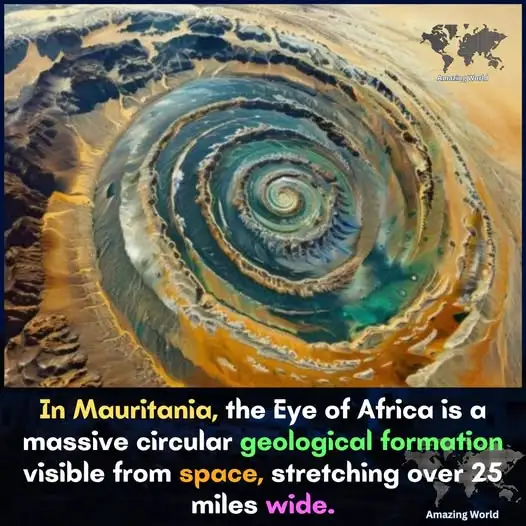
Deep in the heart of the Sahara Desert lies one of Earth’s most fascinating and mysterious formations — the Eye of Africa. Known scientifically as the Richat Structure, this massive circular feature is so large that astronauts can spot it from space. From above, it resembles a giant, watchful eye staring up from the sands of Mauritania — an image both beautiful and haunting.
Stretching over 25 miles (40 kilometers) across, the Eye of Africa has captivated scientists, travelers, and dreamers for decades. It’s not just a geological wonder; it’s a window into the deep past of our planet — a story written in stone, shaped by time, and revealed by erosion.
What Is the Eye of Africa?
The Eye of Africa, or Richat Structure, is a massive, circular geological formation located near Ouadane, a small town in Mauritania, West Africa. From the ground, it might not look extraordinary, but from above — whether seen from an airplane, a satellite, or even the International Space Station — it forms a mesmerizing spiral of rings that look like a colossal eye carved into the desert.
This unique pattern has puzzled scientists for years. Early researchers thought it might have been created by a meteor impact because of its perfectly circular shape. However, later studies revealed that the Eye of Africa wasn’t born from outer space — it was sculpted by Earth itself.
How the Eye of Africa Was Formed
So, how did this massive “eye” come to be? The answer lies in the slow, powerful processes of geology that unfold over millions of years.
The Eye of Africa is believed to be a geological dome — a place where layers of rock were pushed upward by the forces beneath the Earth’s crust. Over time, erosion from wind and water carved away the softer layers, exposing concentric rings of different rock types. These alternating light and dark bands give the structure its eye-like appearance.
Scientists estimate that this natural wonder began forming around 100 million years ago during the breakup of the ancient supercontinent Gondwana. As the land shifted and lifted, layers of sediment and volcanic rock were exposed, creating the circular patterns we see today.
A Natural Record of Earth’s History
Each ring of the Eye of Africa tells a story — a geological diary of our planet’s evolution. The inner rings consist of ancient volcanic rock, while the outer layers hold sedimentary formations shaped by ancient seas and rivers.
By studying these layers, scientists can uncover clues about how Africa’s landscape changed over time — from lush, water-filled basins to the vast desert it is today. The Eye of Africa, in essence, is not just a visual wonder — it’s a scientific time capsule.
The Eye of Africa and Space Exploration
Interestingly, astronauts were among the first to popularize the structure. When NASA missions began orbiting Earth, astronauts often remarked on the sight of a strange, eye-like formation in the middle of the Sahara Desert. Its near-perfect symmetry made it stand out against the endless sea of sand dunes and rocky plains.
Since then, the Eye of Africa has become a landmark for space travelers, helping astronauts visually identify parts of West Africa during orbital missions. It’s a reminder of how connected the worlds of geology and space can be — one revealing the wonders of the other.
Legends and Mysteries of the Eye of Africa
Beyond science, the Eye of Africa has inspired its share of myths and theories. Some enthusiasts have suggested it could be the site of the lost city of Atlantis, described by Plato as a circular city surrounded by water. While there’s no concrete evidence to support that idea, the formation’s unique rings and desert setting certainly fuel the imagination.
Others view it as a natural symbol — a reminder that the Earth itself seems to be “watching” us, keeping the record of its own long and powerful history.
Visiting the Eye of Africa
Despite its remote location, the Eye of Africa has become a dream destination for adventurers, geologists, and photographers. Located in the vast Sahara Desert of Mauritania, reaching it requires effort — typically a guided expedition from the nearest town, Ouadane.
Those who make the journey describe an almost surreal experience. Standing at ground level, you might not see the full circular pattern, but the rugged beauty of the rocks and the sense of ancient power are undeniable. Drone footage or aerial views, however, reveal the full majesty of this incredible formation — a giant spiral in the golden sand, stretching farther than the eye can see.
Travelers often describe visiting the Eye of Africa as humbling — a reminder of how vast and timeless nature truly is.
Travel Tips for Seeing the Eye of Africa
- Best Time to Visit: Between November and March, when temperatures are milder in the Sahara.
- How to Get There: The nearest access point is the town of Ouadane. From there, local guides can help arrange 4×4 tours into the desert.
- What to Bring: Plenty of water, sun protection, GPS navigation, and camera or drone for aerial shots.
Because of its remoteness, it’s best to travel with experienced guides who know the desert terrain and can ensure a safe and educational visit.
Why the Eye of Africa Matters
Beyond its beauty, the Eye of Africa holds deep scientific importance. It offers researchers a rare glimpse into the geological processes that shape our planet. The study of its layers helps us understand erosion, plate tectonics, and how landscapes evolve over time.
For ordinary travelers and dreamers, it represents something even more profound — a symbol of nature’s artistry and mystery. The Eye of Africa is a reminder that some of Earth’s greatest wonders were not built by humans, but carved by time, wind, and the endless patience of the planet itself.
Final Thoughts: The Earth’s Ancient Eye
The Eye of Africa stands as one of the most awe-inspiring natural formations on the planet. Visible from space, shaped by nature, and filled with stories from millions of years ago — it’s a breathtaking reminder of how much beauty lies in the world’s most unexpected places.
If you ever find yourself in Mauritania, take the journey to witness it. You won’t just be looking at rocks — you’ll be staring into the eye of Earth’s history itself.
Sometimes, to understand our world, we have to step back — and look at it from above.
