
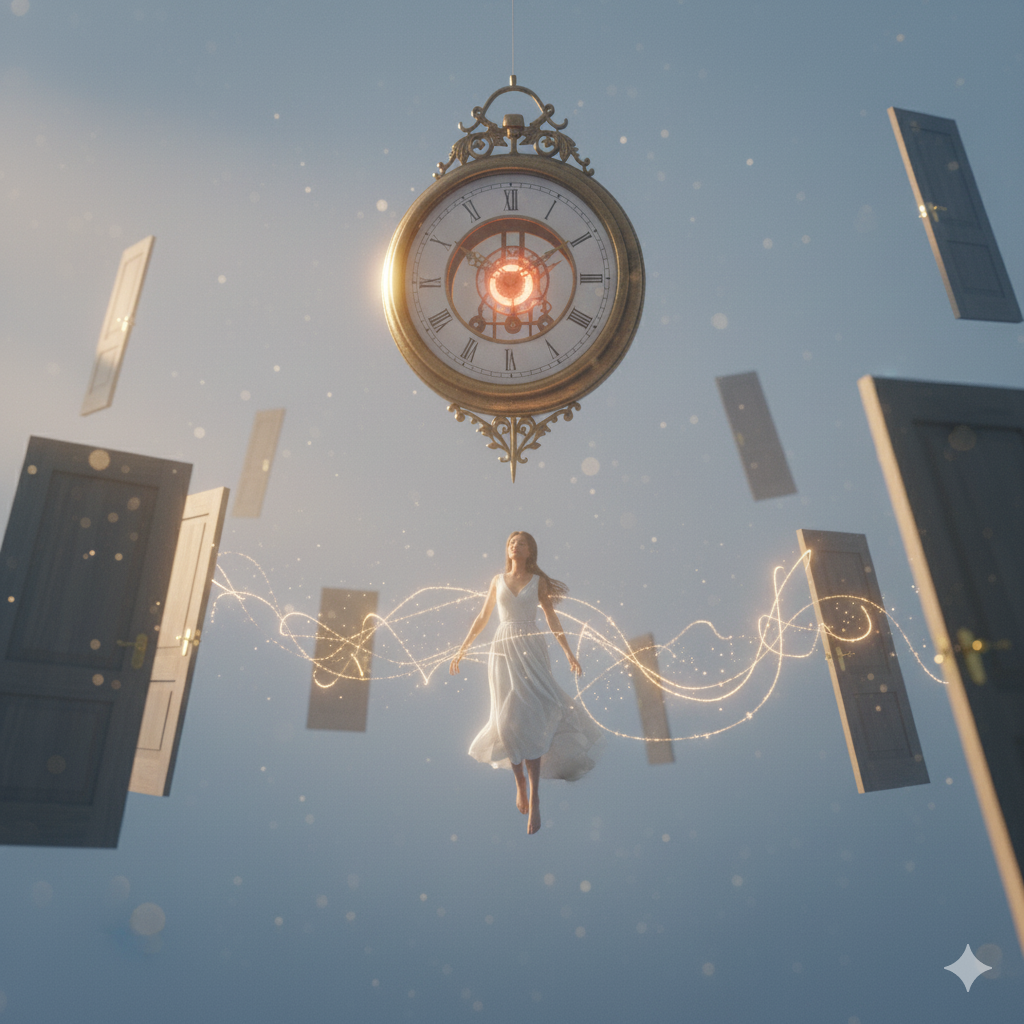
Clara first felt the fall begin in the quiet between two breaths.
She’d been standing in a place that didn’t feel like a place at all—just an enormous, gentle sky that had forgotten to turn blue. Somewhere in that pale infinity, a brass clock hung without chains or ceiling, ticking with the sound of soft rain. The second hand didn’t move. It pulsed—like a heart learning to trust itself.
Below her: nothing. Above her: nothing. Around her: a silence so tender it made her almost cry. She took one step forward to see if the floor would appear and the sky made its choice. Gravity chose her like an old friend.
She fell.
No scream. No wind tearing her face. Just a sensation like sinking into warm water—except there was no water and no bottom. The air shone with faint threads of gold, and in each thread she saw a thin memory: the time she swallowed an apology she needed, the day she kept a promise that wasn’t hers to keep, the year she kept postponing the beginning because she didn’t know who would be disappointed if she didn’t ask permission.
The clock kept pulsing above, growing smaller, then slipping into the distance like a lantern carried down a hall. As she fell, she remembered the first dream that had pressed itself against her life a month ago: a mirror full of fog and a door that wouldn’t open. Each night the door had a keyhole shaped exactly like her breath. Each morning she woke holding air she hadn’t exhaled. She told no one. She simply worked harder at being the person everyone else could predict.
The fall continued. Time stretched thin until it could be braided. She touched one of the gold threads as if it were a string on an instrument. A sound trembled out—something like a lullaby sung by the future. When the sound faded, she felt she wasn’t plummeting; she was being unfastened from weights she’d learned to call “me.”
A voice of light spoke—not from above or below but from inside the falling. “Let go,” it said, not as command but invitation. “Everything that isn’t love, let go.”
“What will hold me?” Clara asked, surprised she could speak without a mouthful of wind.
“Love,” said the light. “Love will hold what you stop carrying.”
The fear that had waited for its cue didn’t arrive. In its place came a catalog of small fears she could finally see clearly: the fear of beginning too late, the fear of being too much, the fear of becoming the person she would have admired if admiration didn’t threaten closeness. She let each fear go the way you release a bird you almost kept because your hands were warm.
The fall deepened. She saw doors drifting past in the sky—thin, bright things with brass handles that matched the clock. Some were locked. Some were open and led to rooms she recognized: a kitchen where she always cooked more than she could eat; a desk with a to-do list written with the quiet hatred of a person trying to outrun exhaustion; a photograph album that opened by itself to a page where a girl with her face laughed like she didn’t need an audience to be real.
As each door passed, she felt herself loosen from it—as if the hinges were not on the door, but on her attention.
A dark shape rose toward her—the bottom, she thought. But when it met her, it wasn’t ground. It was water made of light, holding without grabbing. She didn’t splash. She didn’t sink. She stopped—not as in “ended,” but as in “arrived.” In the luminous water she could see her own outline, fine as a constellation. The voice of light settled around her like a shawl.
“You’re not falling,” it murmured. “You’re being returned.”
“To what?”
“To the part of you that trusts gravity because she knows who made it.”
A breeze she couldn’t feel moved across the water, and the surface became a mirror. In it, she saw herself as she looked now—older than she admitted, younger than she feared, eyes like two questions that had finally found where to sit. Her reflection lifted a hand. When Clara lifted hers, they touched. The mirror warmed.
“Do I stop falling by holding on?” she asked.
“You stop falling by releasing,” said the voice. “By letting go of the last insistence that you must manage everything alone.”
Something like a smile spread through her bones. She pictured all the times she had called self-abandonment kindness and called self-rescue selfish. “Then I let go,” she said, and the moment she said it, she felt the simplest thing—ground. Not a cliff or a floor. A meadow at dusk. The grass accepted her with the indifference of something that loves you whether or not you remember its name.
The brass clock floated down and rested against a tree that belonged to no forest. It ticked once, a sound like a key turning. A door appeared beside it—plain wood, patient. On the door hung a hand-lettered sign that made her laugh with relief: “You may enter from here.”
Clara walked through. On the other side, there was no palace, no choir, no cosmic diploma. There was a room like a morning you’ve been postponing. A table waited with paper and a pen. A sweater lay where someone who loves you left it. A window opened onto soft weather. She sat at the table and realized there wasn’t a test. There was a beginning. She wrote one sentence she had been avoiding: “I am willing to live as if love is the gravity that holds me.”
When she woke, the ordinary ceiling of her ordinary room was imperfect in the way you only notice when you love a place enough to live in it. The ticking of her bedside clock didn’t scold. It kept time with her breathing. She stood, opened her real window, and let the morning find her face without makeup of any kind. She texted the apology. She cancelled the thing she kept saying yes to out of fear someone would stop seeing her as useful. She made tea and drank it slowly, as if slowness were a vitamin.
That night she didn’t fall. She floated above the field. The clock and door were there, faithful as constellations. The voice of light didn’t speak. It didn’t need to. The sky around her had learned her name, and every time it pulsed, she felt something sacred: held.
🌙 Dream Meaning
Falling dreams often arrive when your soul is exhausted from carrying what isn’t yours. Spiritually, they are not punishments; they are initiations into surrender—an invitation to release control, rescue reflexes, and old identities. The hidden medicine is this: the moment you let go, you discover the ground was always love. Falling is the journey back to the arms that made gravity.
