
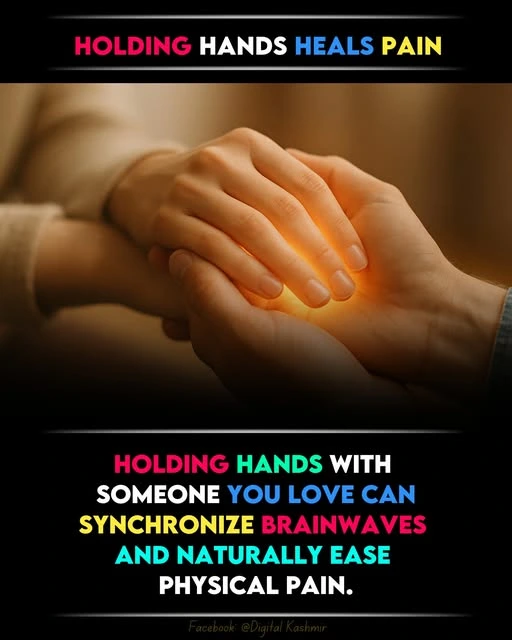
The Science of Holding Hands: How Touch Synchronizes Brains and Reduces Pain
Have you ever noticed how pain feels a little less intense when someone holds your hand?
It’s not just in your head. Science has now confirmed that human touch — something as simple as holding a loved one’s hand — can actually change what’s happening inside your brain. According to researchers at the University of Colorado, this shared connection can synchronize brain activity between two people and reduce physical pain in measurable ways.
In other words, love, empathy, and touch don’t just feel good — they literally help heal us.
💞 The Study That Proved the Power of Touch
In a fascinating study published in the Proceedings of the National Academy of Sciences, scientists explored how physical touch influences the way our brains respond to pain.
Participants were paired up — some were romantic partners, others close friends. Each person was exposed to mild pain stimuli while researchers measured brainwave activity using electroencephalography (EEG). The results were astonishing: when the pairs held hands, their brain patterns began to sync up.
This phenomenon, known as neural coupling, shows that emotional and physical touch create a shared brain rhythm between people. And the more synchronized their brains became, the less pain the person reported feeling.
In simple terms: when someone who loves you holds your hand, your brain literally “feels” their empathy — and responds by dialing down your pain.
🧠 What Happens Inside the Brain
When we experience pain, the brain’s alarm system activates, sending signals through the nervous system that make us tense up and focus on discomfort. But touch changes that story. Researchers found that touch triggers regions of the brain linked to comfort, empathy, and regulation, including the insula and anterior cingulate cortex.
By sharing this emotional energy, the “supporter” helps calm the sufferer’s nervous system. Brainwave synchronization enhances this effect — a kind of shared neural empathy that helps the brain reinterpret pain signals as less threatening.
It’s as if the brain says, “I’m not alone in this,” and the danger signal fades.
❤️ Why Emotional Connection Matters for Healing
Science has long known that stress and isolation increase pain, while connection and compassion reduce it. What this study adds is hard data showing that love can literally be measured in brainwaves.
Holding hands with someone you care about activates the body’s parasympathetic nervous system — the “rest and heal” response. This reduces cortisol (the stress hormone), lowers heart rate, and increases the release of oxytocin, often called the “bonding hormone.”
The result? A calmer body, a quieter mind, and less perceived pain.
That’s why a hug from a friend or a hand squeeze during a tough moment can bring such relief. It’s not just emotional support — it’s biological communication at its most intimate level.
🌍 Touch as a Universal Language
Touch is one of the first ways we connect as humans. Long before we learn to speak, we feel safety and love through contact — a parent’s embrace, a sibling’s hand, a friend’s shoulder. Touch tells us: “You’re not alone. You’re safe.”
As adults, however, many people lose that kind of physical closeness. Digital communication replaces in-person connection. Yet studies show that skin-to-skin contact remains essential for mental and physical health. It boosts immune function, reduces anxiety, and improves overall well-being.
The University of Colorado study reminds us that we’re wired for connection — not just emotionally, but neurologically.
🤝 The Hidden Power of Human Connection
It’s easy to underestimate something as small as holding a hand. But think about it: when you’re scared, in pain, or grieving, what’s the first instinct people have? To reach out and touch.
This isn’t habit — it’s human biology. Our bodies know that touch is medicine.
When two people’s brains synchronize, it creates what some scientists call a “shared emotional space.” It’s a temporary bond that enhances empathy and allows both individuals to feel calmer and more connected. In relationships, this can strengthen trust and communication. In hospitals, it can help patients heal faster. In life, it reminds us that comfort is often found in the simplest gestures.
🩺 The Science Behind Empathy and Pain Relief
Researchers believe that this brain synchronization helps reframe how the brain interprets pain. Instead of focusing on the discomfort, the brain redirects attention toward the shared emotional experience. It’s as if your brain “borrows” the calmness of your partner’s brain, aligning its rhythm with theirs.
This process may explain why patients who receive emotional support often require less medication and recover faster than those who feel isolated. It’s not magic — it’s measurable neuroscience.
🌿 How You Can Use This in Everyday Life
You don’t have to be in a lab to benefit from this phenomenon. Simple daily acts of connection can have powerful healing effects:
- Hold hands with a loved one when they’re stressed or in pain.
- Offer gentle touch — a hug, a pat on the back, or a reassuring squeeze — to show empathy.
- Spend mindful time together. Shared presence and emotional attunement strengthen the same neural bonds that ease pain.
- Be open to touch. Even brief, appropriate physical contact can trigger the brain’s calming pathways.
We often think healing requires pills or complex treatments. But sometimes, it’s as simple as human connection.
💬 Final Thoughts: The Healing Science of Love
This research doesn’t just confirm what many of us feel intuitively — it offers proof that connection heals. Our brains are built to resonate with others, and when they do, something truly profound happens: pain softens, stress melts, and healing begins.
So the next time someone you love is hurting, don’t underestimate the power of your hand in theirs. You might not just be offering comfort — you could be helping their brain heal.
In a world where technology often replaces touch, remember that sometimes, the most advanced medicine is the oldest one: love.
#Neuroscience #HumanConnection #PainRelief #BrainResearch #HealthScience
