
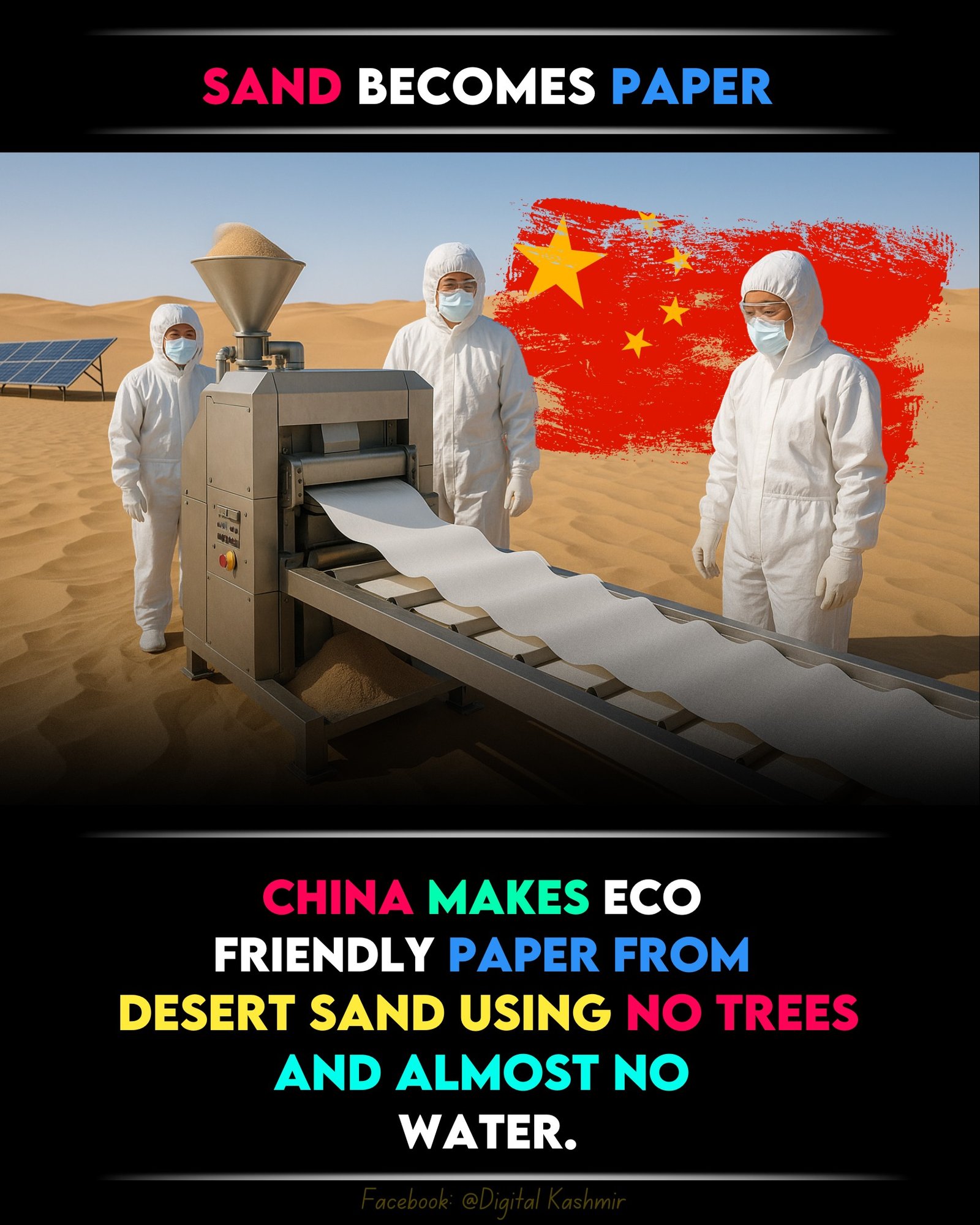
China’s Sand-Based Paper: Turning Deserts Into the Future of Sustainable Materials
For centuries, paper has been both a foundation of human progress and a driver of deforestation. Now, a group of Chinese researchers may have found a groundbreaking alternative — paper made from desert sand.
This innovative material, still in experimental stages, combines sand particles, waste fibres, and resin to create a durable, smooth, paper-like sheet. If proven viable, it could reshape global industries by reducing wood dependency, water consumption, and industrial waste — all while unlocking new economic potential in some of the planet’s harshest landscapes.
🏜️ The Concept: Paper Without Trees or Water
Traditional paper manufacturing depends heavily on wood pulp, a process that consumes millions of trees and vast amounts of water each year. It’s estimated that producing just one ton of conventional paper can require over 300,000 litres of water and contribute to chemical runoff that harms rivers and ecosystems.
The Chinese team’s desert-sand paper proposes a radically different approach.
Instead of relying on cellulose fibres from trees, researchers utilize calcium carbonate from sand grains — the same mineral found in limestone and chalk — as the primary base. By binding these particles with a biodegradable resin and recycled fibres, they’ve created a flexible, printable material that visually and texturally mimics paper.
Unlike traditional pulp, this process reportedly requires minimal water and can use sand sourced from desert regions unsuitable for agriculture, offering both ecological and economic advantages.
⚙️ How It Works: The Science Behind Sand-Based Sheets
The innovation revolves around the microstructure of calcium carbonate, a key mineral component of desert sand. When processed and mixed with eco-friendly resin binders, it forms a smooth, durable, non-toxic surface that can be written on, printed, and potentially recycled.
To enhance flexibility, researchers add waste plant fibres — from discarded paper, agricultural byproducts, or textile remnants — providing strength and texture similar to that of conventional paper.
In early laboratory tests, the resulting material:
- Resisted tearing better than standard paper.
- Repelled water and oil, extending its lifespan.
- Accepted printing ink without smudging or fading.
This unique combination of sand and recycled fibre means the sheet not only avoids tree harvesting but could also reuse industrial and agricultural waste, creating a closed-loop system of sustainable material production.
🌱 Why It Matters: Sustainability on Multiple Fronts
If further research confirms its feasibility, sand-based paper could tackle several pressing environmental challenges:
- Deforestation Reduction
Global paper production consumes over 400 million tons of wood annually, contributing significantly to deforestation. A sand-based alternative could relieve pressure on forests, helping biodiversity and carbon storage. - Water Conservation
Traditional papermaking ranks among the world’s most water-intensive industries. The new process minimizes or eliminates water use — a major breakthrough, especially in arid regions. - Waste Reduction
By incorporating waste fibres and resin derived from recyclable materials, the method could help industries repurpose existing waste streams rather than produce new raw materials. - Desert Utilization
With over one-third of Earth’s land classified as desert, the ability to transform sand into a usable material opens up vast possibilities for economic and environmental innovation.
🔬 Challenges Still Ahead
Despite its promise, the project remains in the testing phase. Researchers caution that large-scale production has not yet been achieved, and the process still requires optimization for:
- Cost efficiency: Scaling production without expensive binders or specialized machinery.
- Durability: Ensuring the material remains flexible under varying humidity and temperature.
- Recyclability: Testing whether sand-paper can be effectively recycled or composted.
- Peer validation: Independent, peer-reviewed studies are needed to confirm performance claims.
Without these verifications, the material remains a concept rather than a commercial solution. However, early data has already caught the attention of sustainability researchers and eco-design firms worldwide.
🏭 A Global Context: Eco Materials on the Rise
China’s innovation joins a wave of new eco-material experiments aiming to replace resource-heavy industrial inputs.
Other notable examples include:
- Stone paper, made from calcium carbonate and resin, already being used for packaging and notebooks.
- Mushroom-based leather, which grows from mycelium and replaces animal hides.
- Banana fibre textiles, an emerging alternative to cotton and polyester.
Each of these breakthroughs signals a global shift toward materials that minimize environmental footprints while meeting modern performance standards.
🌏 Potential Economic Impact
If the desert-sand paper can be industrialized, it could benefit regions often viewed as resource-poor. Desert zones — such as those in China, North Africa, and the Middle East — could become centers for sustainable material production, providing jobs and stimulating green economies.
Moreover, replacing traditional pulp-paper facilities with sand-based alternatives could drastically reduce pollution from chemical bleaching and wastewater discharge.
The environmental cost of paper might finally start to fall.
📚 Looking Ahead
While still experimental, the sand-paper concept reflects a larger truth: innovation often lies in rethinking what’s been overlooked.
For centuries, deserts symbolized barrenness — now, they may become a cornerstone of sustainability.
Whether this material reaches mass adoption depends on continued research, investment, and validation. But its message resonates: humanity’s waste and natural abundance can coexist — and even collaborate — to rewrite the story of production.
