
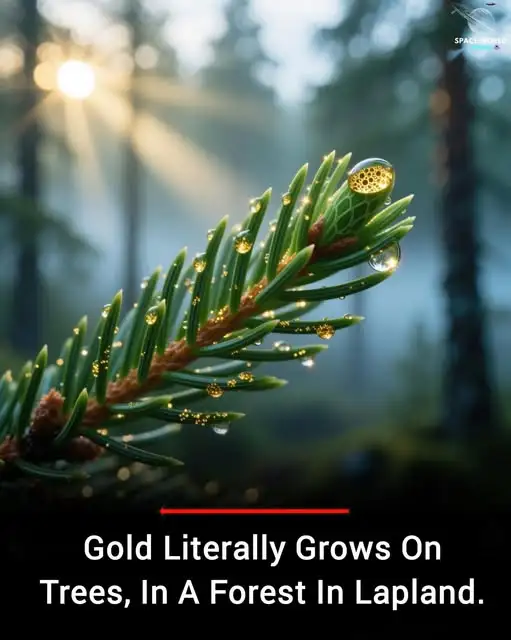
Scientists Discover Gold Forming Inside Trees in Finnish Lapland
What if trees could grow gold? It sounds like something from a fairy tale, but science has just made it real. In the icy forests of Finnish Lapland, researchers have discovered that gold is forming inside the needles of Norway spruce trees — not as shiny nuggets, but as invisible, microscopic particles created by bacteria living within the trees themselves.
This remarkable finding, led by scientists from the University of Helsinki and published in Environmental Microbiome (2025), reveals how nature’s chemistry is far more complex and creative than we ever imagined. Beneath the snow and pine needles, life is literally transforming elements of the Earth — turning dissolved gold from soil into solid nanoparticles inside living trees.
The Spark Behind the Discovery
The team of researchers in Finnish Lapland weren’t looking for treasure. They were studying how microbes help plants absorb and manage minerals. But what they found surprised everyone: tiny traces of gold nanoparticles hidden within the spruce needles.
These nanoparticles were formed through a process called biomineralization — a natural mechanism where living organisms convert minerals from one form to another. In this case, the bacteria living inside the trees acted as tiny alchemists, turning dissolved gold from underground water and soil into solid, nano-sized gold particles.
How Bacteria Turn Soil into Gold
It all starts deep in the soil. Small amounts of gold naturally exist there in a dissolved form, too tiny to see. When water carries these trace elements up through the tree’s roots, the bacteria inside the spruce’s tissues get to work.
Through their natural metabolic processes, these microbes transform the dissolved gold ions into stable nanoparticles. This means that living bacteria are literally “growing” gold inside the tree — not enough to make anyone rich, but enough to fascinate scientists studying how ecosystems interact with metals.
“This discovery helps us understand how biological systems participate in the Earth’s metal cycles,” said a lead microbiologist involved in the project. “It’s not just about gold — it’s about how life continuously reshapes the elements around it.”
Why This Matters for Science and the Planet
While no one will be mining forests for gold anytime soon, this discovery carries huge scientific importance. The presence of gold nanoparticles in living trees could help geologists identify underground gold deposits in a natural, non-destructive way. Instead of drilling or blasting, scientists could study tree samples to map where gold might be concentrated below the surface.
This method could lead to more eco-friendly exploration techniques — protecting the environment while guiding sustainable resource discovery.
Nature’s Hidden Network of Chemistry
Beyond gold, this finding also reshapes our understanding of ecosystems. Trees, soil, and microbes form a vast chemical network where elements are constantly exchanged and transformed. The fact that bacteria can influence precious metal formation shows that nature’s chemistry is deeply interconnected.
In other words, the forest isn’t just alive with plants and animals — it’s alive with chemistry.
What Is Biomineralization?
Biomineralization is the process by which living organisms produce minerals. It’s how shells harden, bones form, and coral reefs grow. Now, thanks to this discovery, we know it’s also how gold nanoparticles can appear inside trees.
The bacteria responsible are known as endophytic microbes — tiny life forms that live inside plant tissues without harming their hosts. These microbes can perform incredible feats of chemistry, often helping plants adapt to environmental stress, absorb nutrients, or resist disease.
In this case, they’ve shown us one more astonishing talent: turning trace minerals into gold dust.
From Tree Roots to Treasure Maps
Scientists believe that this natural process could be used as a tool for mapping underground mineral resources. If trees in a certain area show higher levels of gold nanoparticles, it may indicate the presence of gold deposits below. This method, called biogeochemical exploration, offers a sustainable and low-impact alternative to traditional mining surveys.
In fact, similar techniques have been tested in Australia and Canada, where researchers found that eucalyptus trees can absorb gold through their roots. The Finnish discovery builds on this knowledge, showing that even in cold northern forests, nature continues to perform its quiet miracles.
The Broader Message: Nature as a Chemist
What makes this story truly beautiful isn’t just the gold — it’s what it represents. It’s a reminder that life on Earth never stops experimenting. Bacteria, trees, soil, and minerals are all part of an ancient collaboration that’s been shaping our planet for billions of years.
As one researcher put it, “Nature has been refining chemistry long before humans ever built a lab.”
Gold as a Messenger of Life
Interestingly, the presence of gold nanoparticles inside plants might also tell scientists more about environmental health. By studying these tiny particles, researchers can learn how metals move through ecosystems and how biological systems interact with pollutants or natural resources.
It’s another example of how small discoveries can lead to big insights — not just about gold, but about the balance of life itself.
Lapland’s Living Laboratory
Finnish Lapland, known for its vast forests and pristine environment, has become a living laboratory for climate and biological research. The spruce trees here endure extreme conditions — freezing winters, short summers, and limited sunlight. Yet within them, microscopic life thrives, performing chemistry that connects soil, water, and sky.
The discovery of gold-forming bacteria in this region adds another layer to Lapland’s natural wonder. It shows that even in one of the planet’s harshest environments, life finds creative ways to survive and transform.
Conclusion: When Science Meets Wonder
There’s something poetic about this finding — gold, the symbol of wealth and beauty, quietly forming inside a humble tree. It reminds us that nature is the greatest innovator, constantly reshaping the world in ways we are only beginning to understand.
So next time you walk through a forest, remember: beneath those roots and needles, the Earth is still writing its own quiet alchemy.
Main Keywords: gold forming inside trees, Finnish Lapland gold bacteria, Norway spruce needles, biomineralization, microbial gold, environmental microbiome, University of Helsinki.
