
The Harsh Beginnings of Komodo Dragons: How Baby Dragons Survive Their Deadly World
They hatch into a world that might eat them.
It sounds like something from a fantasy novel — but it’s real life on the Indonesian islands where the mighty Komodo dragon reigns supreme. Before these baby reptiles ever take their first steps, danger is already waiting. Even their own kind could turn on them. In the harsh and untamed world of the Komodo dragon, survival begins the moment the shell cracks.
The World’s Largest Lizard with a Ruthless Start
The Komodo dragon (Varanus komodoensis) is the largest lizard on Earth — a living relic of prehistoric times. Adults can grow over 10 feet long and weigh more than 150 pounds. They are powerful predators capable of taking down deer, boar, and even water buffalo. But before they become the kings of their islands, they must first endure one of the toughest childhoods in the animal kingdom.
For a newborn Komodo dragon, the ground is a battlefield. Life below the trees is filled with predators — wild boars, snakes, birds of prey, and most terrifying of all, adult Komodo dragons. Yes, these giant lizards are cannibals, and they see their young not as offspring, but as food.
Running for Their Lives
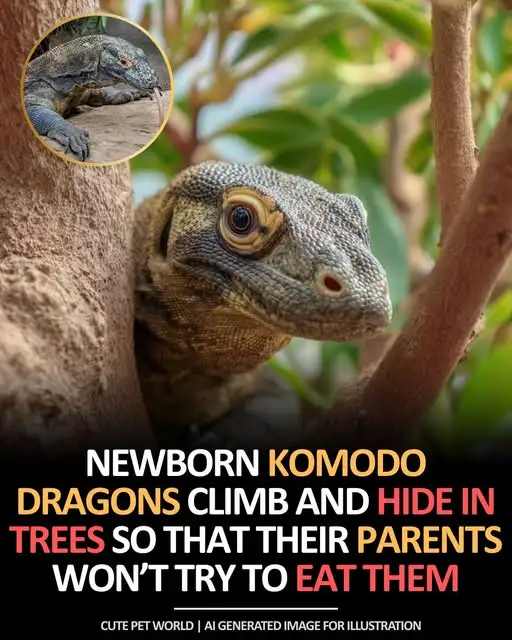
The moment a baby Komodo dragon hatches, instinct kicks in. There’s no waiting, no hesitation. They scramble from the nest and climb — fast. Their tiny claws grip bark, their tails balance their bodies, and they race upward toward the safety of the trees.
Why run from their own kind? Because adult dragons are always hungry. A small hatchling might be nothing more than a bite-sized snack to them. This brutal instinct ensures that only the strongest survive — a harsh but effective law of nature that has shaped the species for millions of years.
The Trees: A Sanctuary Above the Danger
High above the forest floor, the baby dragons find refuge. In the branches, they can rest, feed, and grow without constant fear. Here, they spend the first few years of their lives eating insects, small lizards, and the occasional bird’s egg. It’s a different world up there — cooler, quieter, and, most importantly, safer.
From their leafy lookout, young Komodo dragons learn to sense movement, feel the direction of the wind, and watch for shadows below. Every day is a lesson in patience, awareness, and survival. These instincts are what will eventually guide them back down when the time comes.
Nature’s Harsh Design: Survival by Separation
It might seem cruel that adult Komodo dragons prey on their young. But in nature, everything has a purpose. By driving the hatchlings into the trees, the adults help control their numbers, ensuring that the strongest and most resourceful survive. This balance keeps the species resilient — and in a world as competitive as Komodo Island, that resilience means everything.
It’s not emotionless cruelty — it’s survival. The adults rule the ground, and the young rule the branches. Only when the juveniles are big enough — strong enough — do they risk returning to the ground to claim their place among the giants.
From Hatchling to Hunter
As months turn into years, baby Komodo dragons grow quickly. They feed on whatever they can catch — grasshoppers, geckos, even small rodents. Over time, their appetite — and their courage — grows. Once they reach about four years old and weigh 20 pounds or more, they start to venture down from the trees.
When that moment comes, they trade leaves for dust. The world below, once a place of danger, now becomes their new territory. They begin to stalk larger prey, using stealth and patience learned from years of observation above. Slowly, they step into the role they were born for — apex predator.
The Komodo Dragon’s Deadly Power
By adulthood, Komodo dragons are near-perfect hunters. Their long claws, powerful tails, and sharp teeth make them formidable. But their true weapon lies in their bite. Komodo dragons possess venom glands that deliver toxins, weakening prey with shock and blood loss.
Once they strike, their prey rarely escapes. A wounded animal may wander off, only to collapse hours later — and the Komodo dragon’s keen sense of smell leads it right back to the carcass. It’s a chilling but efficient system honed by evolution.
The Balance of Fear and Power
The story of the Komodo dragon is one of contrast — fragility and ferocity, fear and dominance, life and death intertwined. The tiny hatchling that once clung to a tree branch will one day rule the ground it once fled. And perhaps that’s the greatest symbol of nature’s design: every creature has its time, and every struggle has its purpose.
Up in the trees, the young dragons wait out their dangerous years. Down below, the adults reign — until the next generation is ready to descend. The cycle continues, as it has for millions of years, on the remote islands of Indonesia where these living dragons still walk the earth.
What Komodo Dragons Teach Us About Survival
Watching how Komodo dragons survive reminds us that strength is rarely given — it’s earned. Every claw mark, every branch climbed, every close call is part of a greater story of persistence. Nature’s lessons aren’t always gentle, but they are powerful.
The Komodo dragon doesn’t grow fierce overnight. It climbs, hides, learns, and waits. It teaches us that sometimes, retreat isn’t weakness — it’s strategy. The trees aren’t just shelter. They’re training grounds.
Final Thoughts: The Trees Are Hope
For a baby Komodo dragon, the trees mean everything — safety, food, and a chance at life. Each one that survives the climb may one day walk the same trails as its ancestors, ruling the land it once feared.
So when you see a Komodo dragon basking in the sun, remember: it started small. It started afraid. It started in the branches, clinging to life against impossible odds. And it survived — not by strength alone, but by instinct, patience, and will.
The trees are home. The trees are safety. The trees are hope.
References: San Diego Zoo Wildlife Alliance | Encyclopaedia Britannica | National Geographic Kids
