
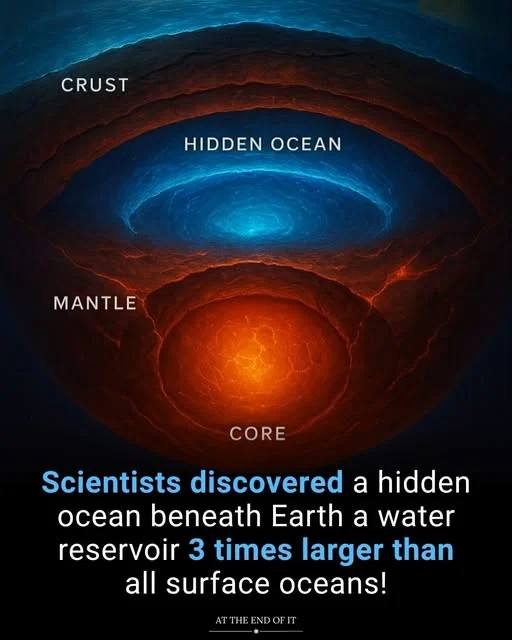
The Hidden Ocean Beneath Our Feet: Scientists Discover a Massive Water Reservoir Deep Inside Earth
What if the largest ocean on Earth wasn’t the Pacific — but one buried hundreds of kilometers beneath your feet?
In a groundbreaking discovery, researchers have identified a massive underground water reservoir about 660 kilometers (410 miles) beneath the Earth’s surface. This hidden ocean, trapped inside a blue mineral called ringwoodite, could contain three times more water than all of Earth’s surface oceans combined.
That’s right — an entire ocean locked away in the planet’s mantle. It doesn’t flow or shimmer like the seas we know, but it may quietly influence volcanoes, earthquakes, and even life on the surface.
The Astonishing Discovery: Water Hidden in Stone
This revelation came after years of research by scientists analyzing seismic waves — the vibrations that travel through Earth during earthquakes. These waves behave differently when passing through various materials. By studying them, researchers realized there was something extraordinary lurking deep within the planet’s mantle.
At around 660 kilometers deep, they found water trapped within ringwoodite — a rare, high-pressure form of olivine that can hold water inside its crystal structure. But this isn’t liquid water. It’s bound at the molecular level, locked within the mineral itself like a sponge soaked from within.
This discovery confirms what geologists have long suspected — that the Earth’s interior contains vast amounts of water, not in oceans or lakes, but hidden inside rocks under immense pressure and temperature.
How Much Water Are We Talking About?
Scientists estimate that this underground reservoir could contain up to three times the volume of all our surface oceans combined. Imagine the Pacific, Atlantic, Indian, and Arctic Oceans together — then triple it. That’s the scale of this hidden ocean beneath our feet.
This means the Earth’s total water inventory is far greater than we ever imagined. It reshapes our understanding of the planet’s hydrological cycle — the constant movement of water through evaporation, rainfall, and ocean currents.
In fact, some researchers believe this underground water might act as a “regulator” for Earth’s surface oceans, helping to maintain their stability over billions of years.
What Exactly Is Ringwoodite?
Ringwoodite is a unique mineral that forms only under extreme pressure — conditions found about 400–700 kilometers deep in the Earth’s mantle. Its crystal structure can trap water molecules within, holding them in a solid, stable form.
In 2014, scientists first found a tiny sample of ringwoodite from deep inside the Earth, brought to the surface by volcanic eruptions. That single fragment contained about 1.5% water by weight — confirming that water is present in the planet’s deep interior.
This new research builds on that discovery, showing that entire layers of the mantle could be rich in this mineral, effectively forming a “deep Earth ocean” — one that we can’t see, touch, or swim in, but that plays a vital role in shaping our world.
Why This Matters: The Hidden Engine of Earth’s Balance
This discovery isn’t just fascinating — it could help explain how Earth has maintained its oceans and atmosphere for billions of years.
1. Regulating Surface Oceans
Over geological time, Earth’s oceans have remained remarkably stable in size. If all volcanic activity and plate tectonics simply recycled water without balance, our oceans could have boiled away or flooded the continents long ago. Scientists now believe the mantle’s hidden water reservoir acts as a buffer, storing and releasing water over time to keep surface levels consistent.
2. Fueling Volcanoes and Plate Tectonics
Water affects how rocks melt deep underground. The presence of water in the mantle can lower the melting point of rock, fueling volcanic activity and driving plate tectonics — the movement of Earth’s crust that shapes continents and triggers earthquakes.
In other words, without this hidden water, Earth’s surface might be geologically “dead,” like Mars. Our planet’s unique habitability may depend on the silent work of these buried oceans.
3. Supporting Life — From Below
Though this deep water isn’t drinkable or accessible, it plays an indirect but crucial role in life’s survival. By stabilizing the planet’s environment, recycling materials, and enabling geological processes, the water trapped in ringwoodite could be one of the reasons Earth has stayed alive and vibrant for billions of years.
A New Chapter in Earth Science
This finding challenges everything we thought we knew about the planet’s structure. For decades, scientists pictured Earth’s layers — crust, mantle, outer core, inner core — as mostly dry zones with limited water. Now, we know that the mantle isn’t just rock — it’s a dynamic, water-rich region essential to the planet’s stability.
NASA, ScienceAlert, and Nature have all reported on this stunning discovery, emphasizing that it reshapes our understanding of how Earth’s water cycle functions. It’s no longer just an atmosphere-to-ocean loop — it’s a planet-wide system that reaches deep into the mantle.
Could This Change How We Search for Life on Other Planets?
Absolutely. This hidden ocean gives scientists new insight into how planets store and circulate water — a key factor in determining their habitability. If water can exist deep within the mantle, even dry-looking planets might harbor water-rich interiors.
This could revolutionize how we search for life beyond Earth. Planets and moons with internal water reserves might have the conditions necessary to support life — not on their surface, but within their cores.
Our Planet’s Quiet Miracle
It’s humbling to think that beneath the ground we walk on lies a hidden world — a vast reservoir that silently keeps Earth in balance. Every drop of ocean water, every rainfall, every volcanic eruption — all may be influenced by this deep, unseen force.
In the words of one researcher, “We’re still discovering what our planet really is.” And maybe that’s the most inspiring part. After centuries of exploration, Earth continues to surprise us — reminding us that even the most familiar world we know still holds extraordinary secrets.
Final Thoughts: The Ocean Beneath Us
From space, Earth looks like a blue marble — the water planet. But now, we know that its blueness runs deeper than we ever imagined. Beneath the crust, hidden within the mantle, an ancient ocean waits — shaping the surface, nurturing the atmosphere, and sustaining life from below.
It turns out the greatest ocean on Earth isn’t above us. It’s beneath us.
