
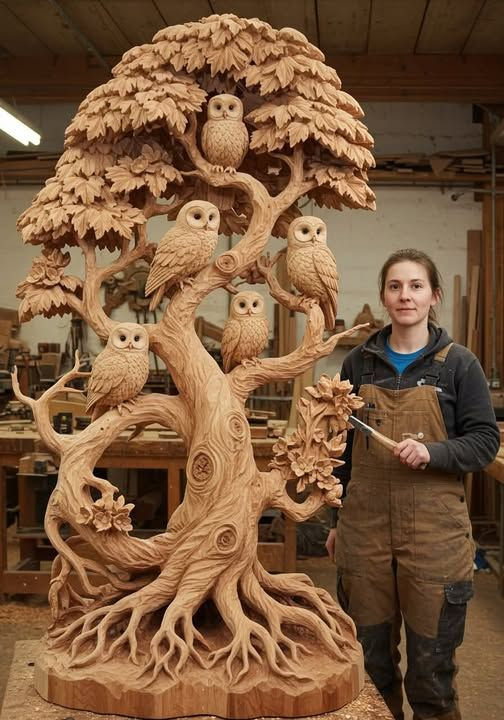
When the town bell stopped meaning anything and words felt thin, she went into the workshop and started talking — with wood. What she carved wasn’t just a tree with owls: it became a place where people came to remember, forgive, and finally breathe again.
The first cut
The piece began as a single salvaged trunk, a rough circle of grain she’d pulled from a neighbor’s storm-felled maple. She planned to make a small stool. But the morning her husband left — not with anger, but with a silence so big she couldn’t name it — her hands found a different rhythm. She shaped a root. Then another. The roots wrapped and climbed like a promise. By nightfall she’d sketched the first owl’s face, and the whole project breathed into being.
Why owls?
They were her grandmother’s symbol. As a child she’d watched the old woman leave tiny carved owls on windowsills for neighbors who’d lost something — a job, a child’s first tooth, a house key. “Owls listen,” her grandmother used to say. “They keep secrets safe until you can say them.” When life stripped the town of certainty — layoffs, quiet arguments, and those people who never learned to say sorry — she chose owls because listening was the medicine everyone needed but rarely admitted wanting.
The work that healed
Day after day she worked under the workshop’s warm lamp. Neighbors dropped by with coffee and a cautionary optimism. Teenagers sat on crates and mopped the floor while she sanded. An old man who hadn’t spoken since his wife’s funeral whistled off-key and left with a tiny shavings bird in his pocket. Little by little the carved tree became a community thing: the maple’s knots became faces; the branches became meeting places; the owls — six in all — each found a personality. One looked like forgiveness. One looked like stubbornness. One looked like the child who once broke the bakery window and later became mayor. People began to visit, stand in front of it, and tell a piece of their day to the wood.
The night that changed everything
A storm came in October. The river rose, and the town’s oldest house — the place where her grandmother had once lived and taught her to carve — was flooded. The family that lived there had lost almost everything. At dusk the woman carried the carved owl that represented “listening” to that family’s porch and left it on their table. The next morning, the town was different. The family had cleaned the neighbor’s steps, handed out bread, and read letters aloud from boxes thought lost. People said it was a small thing — a carved owl — but sometimes small things are anchors.
A secret revealed
Months later, during the town’s harvest fair, she stood next to the tree and listened as strangers told her stories they’d never told anyone else: a son confessing a mistake he’d hid for twenty years, a woman reading a letter she’d never mailed, a man thanking the neighbor who’d kept his late wife company. Each confession hung like a leaf falling into her lap. She realized the sculpture had become a safe place to be seen without being judged. She had not set out to fix the town. She had only wanted to keep working. The wood had done the rest.
Why this matters
Art is often praised for beauty. But the carved tree — with its owls and winding roots — shows another truth: art can be a quiet doorway. It can give people permission to stop being brave for once and to be human. It can hold memory. It can hold sorrow and shape it into something people can touch and share.
She never sold the tree. It stands by the workshop window where the light catches the grain every morning. People still come, not just to look, but to leave pieces of themselves: a note tucked between roots, a coin balanced under an owl’s claw, a photograph slid into a hollow. If you visit, you might find your own thing there to offer — or to let go. Either way, you’ll leave quieter than you arrived, as if you’ve just been heard.
