
Just One Fast-Food Meal Can Affect Your Brain — Here’s What Science Says
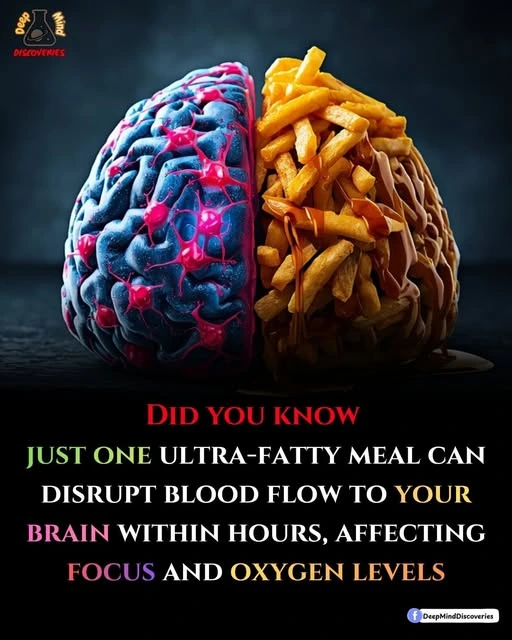
We’ve all been there — you grab a fast-food meal after a long day, thinking one indulgence won’t hurt. But according to new research, even one high-fat meal may temporarily damage how your brain functions. That’s right — a single “treat” could disrupt your brain’s blood flow within just a few hours.
In a new study, scientists found that consuming a milkshake with more than 1,300 calories and 130 grams of fat — similar to a typical fast-food combo meal — significantly impaired the brain’s ability to regulate blood flow. The drink, made mostly of heavy cream, was dubbed the “brain bomb.”
Within four hours, both young and older adults in the study showed measurable reductions in how efficiently blood vessels in the brain responded to changes in blood pressure. That’s not just science jargon — it means their brains became less capable of maintaining a steady flow of oxygen and nutrients.
🧠 The Study That Shocked Researchers
The research, recently published and summarized by ScienceAlert, tracked healthy adults aged 18–35 and 60–80. Each participant drank the high-fat shake, then underwent a series of tests that measured cerebral autoregulation — the process that keeps blood flow to the brain stable despite fluctuations in blood pressure.
The results were clear: both groups showed reduced brain blood-flow regulation just four hours after consuming the shake. However, the effect was much stronger in older adults — around a 10% greater reduction compared to the younger participants.
That might not sound like much, but even a small disruption in blood flow can matter. The brain depends on a constant, precise supply of oxygen and nutrients. Any reduction in that ability, even temporarily, can increase vulnerability to issues like cognitive fog, dizziness, and — over time — conditions like stroke or dementia.
🍔 What’s in the “Brain Bomb” Shake?
The shake wasn’t a random concoction — it was carefully designed to mimic the fat content of a typical fast-food meal: think a burger, fries, and a milkshake together. In total, it packed 1,362 calories and 130 grams of fat.
Most of that fat came from heavy whipping cream, which is rich in saturated fats. These fats are known to stiffen blood vessels and promote the formation of harmful molecules called free radicals. Combined, they can cause blood vessels to lose flexibility — which is exactly what the study observed.
⚠️ How One Meal Impacts Your Brain
Normally, when blood pressure rises or falls, tiny arteries in your brain adjust instantly to keep blood flow consistent. This regulation ensures the brain gets the oxygen it needs, regardless of what your body is doing. But after consuming the high-fat shake, that system didn’t work as well.
The researchers believe the fat overload caused oxidative stress — an imbalance between free radicals and antioxidants in the body. This stress damages the lining of blood vessels, reducing their ability to expand and contract smoothly.
It’s like taking a flexible garden hose and freezing it into a rigid pipe. The flow becomes harder to control, and over time, the system weakens.
👴 Why Older Adults Are at Greater Risk
For younger people, the brain can usually bounce back quickly after one high-fat meal. But for older adults, whose arteries are already less elastic, this temporary damage could be more serious.
The study found that older participants experienced about a 10% greater drop in cerebral blood-flow regulation. Researchers warn this might push brain function closer to risk zones for vascular problems, such as stroke, cognitive decline, or dementia.
“Even a single indulgent meal can have measurable effects,” one of the lead researchers noted. “We often underestimate how sensitive our vascular system is to what we eat.”
🔥 The Link Between Fat, Free Radicals, and Brain Function
This isn’t the first time science has linked high-fat meals to brain health issues. Previous studies have shown that these foods can reduce levels of nitric oxide — a molecule that helps blood vessels stay flexible and open. At the same time, they increase oxidative stress and inflammation.
Over time, this combination can set the stage for chronic conditions like high blood pressure, insulin resistance, and memory decline.
While the recent study didn’t directly measure cognitive function, earlier work by the same team found that high-fat meals can impair memory and attention in the short term. The effects appear reversible — but only if unhealthy eating doesn’t become a habit.
🍟 What This Means for Your Next Fast-Food Craving
Does this mean you can never have fries or a milkshake again? Not necessarily. The problem isn’t the occasional treat — it’s how frequently these “brain bombs” appear in our diets.
If you regularly eat meals high in saturated fat, your brain’s blood vessels could become less responsive over time. That means less oxygen to key brain areas and potentially faster cognitive decline.
To protect your brain, nutrition experts recommend focusing on healthy fats — the kind found in avocado, olive oil, nuts, seeds, and fish. These fats promote circulation, reduce inflammation, and support brain function.
💡 5 Simple Ways to Support Brain Blood Flow Naturally
- 1. Choose smart fats. Swap saturated fats for sources like olive oil, almonds, and salmon.
- 2. Stay hydrated. Dehydration reduces blood volume, which can strain your brain’s vascular system.
- 3. Exercise regularly. Even brisk walking improves circulation and boosts nitric oxide levels.
- 4. Get enough sleep. Sleep helps repair blood vessels and balance oxidative stress.
- 5. Limit processed foods. Fast food and fried items contribute to inflammation and vessel stiffness.
🧩 The Bigger Picture: Food and the Brain Connection
What makes this study so important is its reminder that food isn’t just fuel — it’s information for your body. Every bite you take sends chemical signals that influence how your brain, heart, and blood vessels function.
Eating a single high-fat meal might not cause lasting harm, but repeated indulgence sends the message: “make the vessels stiffer, make blood flow harder.” Over time, that message becomes your new normal.
Fortunately, the reverse is also true. A single healthy meal — rich in fiber, antioxidants, and good fats — can improve blood vessel flexibility and boost brain performance.
🥗 The Takeaway: Your Brain Feels What You Eat
The “brain bomb” study offers a sobering reality check: even one fast-food-style meal can temporarily impair how your brain receives oxygen and nutrients. And if that meal is a daily habit, the effects can compound over time.
The next time you crave that drive-thru milkshake or greasy burger, remember — your brain will feel it, too.
Eat smart, think clear, live long.
Source: “Just One High-Fat Meal Can Disrupt Blood Flow to Your Brain, Study Finds,” ScienceAlert, Aug 8, 2025.
#BrainHealth #Nutrition #FastFoodFacts #HealthyEating
