
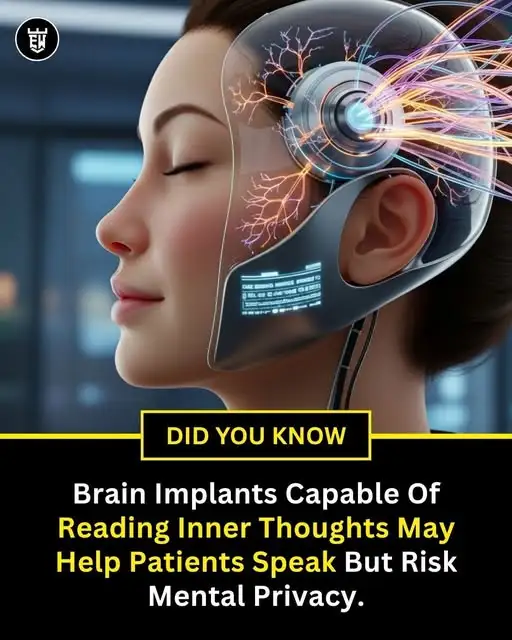
Brain Implants That Can Read Thoughts: The Future of Communication or a Threat to Privacy?
Imagine a world where your thoughts could be translated into words — where silence is no longer a barrier to expression. It might sound like science fiction, but that world is closer than ever.
Thanks to breakthroughs in brain implant technology, researchers have begun to decode neural signals linked to speech, allowing machines to literally “read” the brain. For people who cannot speak due to paralysis, stroke, or severe neurological conditions, this technology could offer something priceless: a voice.
Yet, as with any major scientific leap, it comes with questions that touch the very core of what it means to be human.
When Science Gives the Mind a Voice
For decades, scientists have dreamed of creating a direct bridge between the brain and machines — a way to restore lost communication for those trapped inside silent bodies. Now, that dream is becoming reality.
Researchers have developed brain implants that detect electrical patterns connected to speech. These signals, when decoded through artificial intelligence, can be turned into spoken words or text on a screen. The result? People who haven’t been able to speak for years can finally communicate again.
In one remarkable study, a woman who lost her voice after a stroke was able to “speak” again using a digital avatar powered by her brain signals. Every thought she intended to say was decoded and spoken aloud — a conversation reborn through technology.
The Technology Behind Thought-to-Speech
How does it actually work? The process is both elegant and astonishingly complex.
Electrodes implanted in specific regions of the brain pick up neural activity when a person imagines speaking. These signals are then analyzed by advanced AI algorithms that learn to associate certain patterns with specific words or phrases. Over time, the system becomes more accurate, translating thoughts into speech almost instantly.
It’s like the brain whispering to a computer — and the computer responding in a human voice.
Unlike traditional communication aids that rely on eye movement or typing, brain-computer interfaces work directly with the mind itself. They bypass physical limitations, offering a revolutionary new form of human connection.
A New Dawn for People Living in Silence
For patients with paralysis, ALS, or severe brain injuries, losing the ability to communicate can feel like losing a piece of identity. Brain implants offer hope where words have been lost.
Imagine a father who can finally tell his children he loves them after years of silence. Or a woman with ALS who can express her thoughts, jokes, and dreams once more. These are not distant possibilities — they are happening in labs and hospitals today.
It’s not just about speaking. It’s about reclaiming humanity — dignity, agency, and emotional connection. The power of communication lies at the heart of being human, and these implants are rewriting that story.
But What About Mental Privacy?
As incredible as this technology sounds, it also opens a door to questions that society has never had to face before.
If machines can read brain signals, where do we draw the line? Who owns your thoughts? What happens if this technology is used without consent — or for purposes beyond medical care?
Experts warn that mental privacy could become the next major human rights issue. The brain is our most personal space, the home of every secret, fear, and dream. If technology can peer into that space, the consequences could be profound.
While today’s implants require surgery and focus on restoring communication, future versions might become less invasive — possibly even wearable. That accessibility could be both revolutionary and risky.
Science Is Moving Faster Than Ethics
One of the biggest challenges isn’t the technology itself — it’s the ethical framework around it. Regulation and public understanding lag far behind scientific progress.
Many researchers agree that before this technology becomes mainstream, we need clear rules on consent, data ownership, and mental protection. Brain data is far more personal than any other kind of information — it’s the essence of our identity.
Some philosophers have begun calling for “neurorights” — new laws to protect people from unauthorized access to their neural data. Just as privacy laws protect your digital information, neurorights would protect your thoughts.
Could Thought-Reading Be Misused?
Imagine if employers, governments, or corporations gained access to brain-reading tools. Could they detect honesty, predict behavior, or even manipulate emotions? These scenarios may sound dystopian, but history shows that powerful technologies often invite misuse.
That’s why researchers emphasize strict medical boundaries and ethical transparency. Brain implants must remain tools of healing — not control.
Balancing Innovation and Humanity
The potential benefits of brain-computer interfaces are undeniable. They can give a voice to the voiceless, restore independence, and help doctors understand brain diseases better than ever before.
But as we move forward, we must ask the right questions: How do we balance progress with privacy? How do we ensure that science serves humanity, not the other way around?
The answer lies in collaboration — between scientists, ethicists, lawmakers, and everyday citizens. Technology should always reflect our values, not redefine them without consent.
The Future of Communication Is Both Exciting and Fragile
We are entering an era where thoughts can become words, and silence can be broken with science. This is more than a medical innovation — it’s a philosophical turning point.
The human brain is a masterpiece, and unlocking its signals could change how we understand ourselves. But as we explore that power, we must remember: not everything that can be decoded should be.
Brain implants that read thoughts may help millions, but they also remind us of something timeless — that privacy, choice, and the right to our inner world are sacred.
Final Thoughts
Technology is giving humanity new tools to heal and connect. The ability to translate thoughts into words is a miracle of modern science — one that could restore dignity and hope to countless lives.
Yet the same technology challenges us to protect what makes us human: our freedom to think privately, to dream without intrusion, and to share our minds only when we choose.
The future of brain implants is not just about engineering the mind — it’s about safeguarding the soul.
#Neuroscience #BrainTech #MentalPrivacy #Innovation #Ethics #FutureOfMedicine
