
Scientists Say Dark Matter May Not Be in Our Universe — But in a Hidden One Right Next Door
What if the greatest mystery in science isn’t hiding in deep space — but in a universe right beside our own?
For decades, physicists have been chasing an invisible ghost: dark matter. It’s the mysterious substance that makes up about 27% of the universe, holding galaxies together like cosmic glue. Without it, stars would scatter into the void, and galaxies — including ours — would simply fall apart.
Yet for all our technology and effort, no one has ever directly detected a single dark matter particle. Every telescope, detector, and experiment has come up empty-handed. And now, some scientists believe the reason might be more mind-bending than anyone imagined — maybe we’ve been looking in the wrong universe.
The Cosmic Mystery of Dark Matter
Dark matter has puzzled scientists since the 1930s, when astronomer Fritz Zwicky first noticed galaxies were spinning faster than visible matter could account for. Something unseen was providing extra gravity — a massive, invisible presence anchoring the cosmos.
Over the years, we’ve ruled out dust, gas, and regular matter. We’ve imagined exotic particles like WIMPs (Weakly Interacting Massive Particles) and axions. We’ve built detectors deep underground to catch the faintest sign of a collision. Still, nothing.
So if dark matter isn’t in our universe — where is it?
A “Mirror Universe” Made of Dark Matter
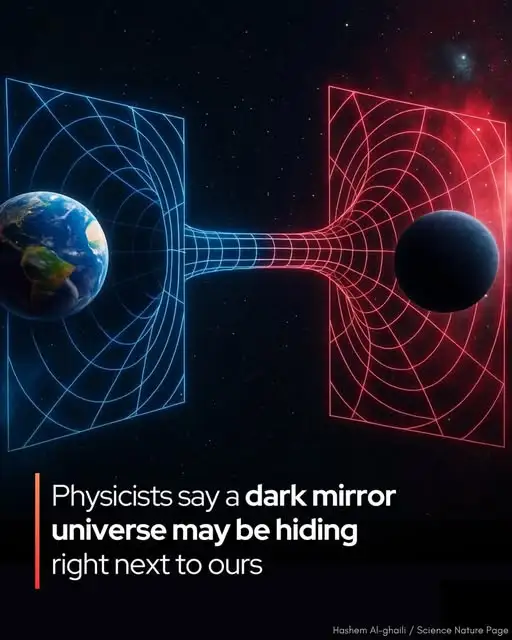
Physicist Stefano Profumo of the University of California, Santa Cruz, has a bold idea: dark matter may belong to a hidden mirror universe that formed alongside our own.
Imagine that during the Big Bang, not one but two universes were born — twins separated by a thin, invisible veil. One, the universe we live in, is made of regular matter: atoms, light, and energy. The other is made entirely of dark matter — a shadow world with its own atoms, forces, and even dark stars and dark black holes.
We can’t see this mirror universe, because its light doesn’t interact with ours. But we can feel its pull. Its gravity could be what’s keeping our galaxies stable — an unseen hand shaping the visible universe.
Profumo describes this relationship as a kind of cosmic dance. Both universes may exist side by side, gravitationally linked yet invisible to one another — like reflections moving in perfect sync, separated by an invisible glass.
Could There Be Life in the Mirror Universe?
It sounds like science fiction, but it’s rooted in real physics. If this dark mirror universe has its own laws, atoms, and energy, it’s not impossible that some form of structure — even life — could exist there. Not like ours, of course, but in ways we can’t yet comprehend.
After all, our entire reality was once invisible until we built instruments to see beyond the limits of human sight. Radio waves, X-rays, neutrinos — all once hidden. Who’s to say we won’t one day find a way to glimpse this neighboring universe?
Another Bold Theory: Dark Matter From the Edge of the Universe
Profumo’s research doesn’t stop there. He also explores a second idea — one that reimagines the very edge of space and time.
What if dark matter isn’t just hidden — but still being created?
According to his theory, the universe’s expanding boundary — the “edge” of spacetime itself — could be emitting dark matter, just as black holes emit radiation from their event horizons. This process might have begun right after the Big Bang and could still be happening today, slowly generating dark particles that flow into our cosmos like a steady, invisible tide.
If true, that means dark matter isn’t just a leftover from the birth of the universe — it’s an ongoing creation, constantly shaping reality in ways we can’t yet measure.
Why We’ve Never Found Dark Matter (Yet)
Every major experiment, from the CERN Large Hadron Collider to underground detectors buried beneath mountains, has searched for dark matter particles. Each time, scientists expected a breakthrough. Each time, silence.
But if dark matter exists in a different layer of reality — one that doesn’t interact with our electromagnetic forces — then our detectors were never designed to find it in the first place. We may need new physics, new instruments, even new dimensions of thinking.
In short: maybe we’ve been searching in the wrong place all along.
Science Catches Up to Ancient Wonder
Interestingly, the idea of “mirror worlds” isn’t entirely new. Philosophers and mystics throughout history have imagined parallel realities — unseen layers of existence coexisting with ours. What’s astonishing is how modern physics is beginning to echo these ancient intuitions, replacing mysticism with mathematics.
Quantum theory, multiverse models, and string theory all suggest the universe may not be alone. Now, dark matter might be the gravitational fingerprint of one of those hidden worlds — a universe right next door.
The Beauty of Not Knowing
For all the precision of science, the cosmos still humbles us. Every discovery seems to open more questions than it answers. And maybe that’s the point.
As Profumo himself puts it, “We don’t have all the answers, but that’s what makes this so thrilling. Dark matter might just be the universe’s way of reminding us that the story isn’t finished.”
We live in a moment where the line between science and wonder grows thinner every day. Whether dark matter lies in our universe or in a hidden one next door, the search connects us to something larger — a cosmic mystery that began long before us and will outlast every star we know.
Final Thoughts: The Universe May Be Bigger Than We Ever Imagined
It’s easy to think of space as vast and empty, but maybe it’s not empty at all. Maybe it’s crowded — with invisible matter, unseen worlds, and parallel universes brushing against ours like waves in the same cosmic sea.
Dark matter might not be missing — it might simply be elsewhere. Hidden. Waiting for us to learn how to see what’s always been right beside us.
The truth may not be out there. It may be next door.
