
Meta Description:
Discover how honeybee venom and its key compound, melittin, are showing remarkable potential in destroying aggressive breast cancer cells and enhancing chemotherapy effectiveness.
Introduction: Nature’s Unexpected Weapon Against Cancer
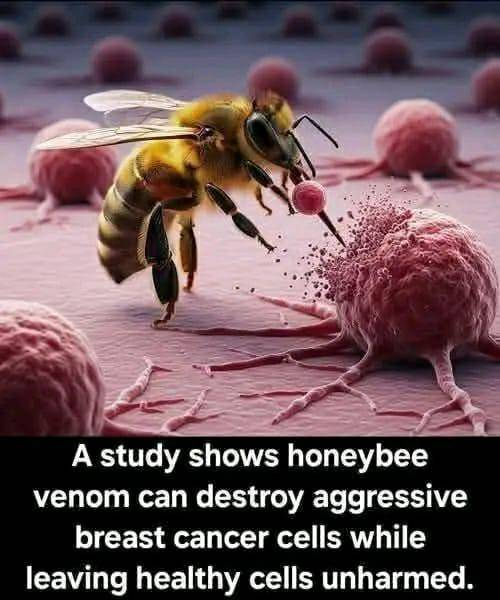
In a groundbreaking discovery, scientists have found that honeybee venom, a natural substance produced by one of the world’s most important pollinators, contains a compound that may help fight some of the most aggressive types of breast cancer.
The compound, known as melittin, has demonstrated the ability to kill cancer cells and disrupt tumor growth pathways, sparking new hope for natural and targeted cancer treatments.
This promising research, conducted by scientists from the Harry Perkins Institute of Medical Research in Western Australia, has caught global attention for its potential to revolutionize future cancer therapies.
What Is Melittin?
Melittin is the main active compound found in honeybee venom. It makes up nearly half of the venom’s dry weight and is known for its anti-inflammatory, antiviral, and antimicrobial properties.
However, scientists have recently discovered a new role for melittin — one that could redefine how we approach cancer treatment.
According to Professor Peter Klinken, Western Australia’s Chief Scientist, melittin can block cellular signals that promote cancer growth. These signals often activate receptors that make certain cancers difficult to treat, particularly triple-negative and HER2-positive breast cancers.
How Honeybee Venom Targets Cancer Cells
In laboratory experiments, melittin showed the ability to selectively target cancer cells while leaving healthy cells largely unharmed.
This selectivity is crucial because traditional cancer treatments, such as chemotherapy and radiation, often damage both healthy and cancerous tissues — leading to significant side effects.
Professor Klinken explained that melittin works by disrupting specific cancer cell receptors, particularly EGFR (epidermal growth factor receptor) and HER2.
Both receptors are key drivers in aggressive breast cancer types. By blocking their signals, melittin effectively stops the cancer cells from multiplying and spreading.
“Melittin disrupts key pathways in breast cancer cells by inhibiting receptors like EGFR, commonly elevated in triple-negative breast cancer, and HER2, which is overactive in HER2-enriched cases,” said Professor Klinken.
A Natural Compound With Therapeutic Potential
This discovery reinforces the growing belief that nature provides powerful bioactive compounds capable of addressing complex diseases.
Researchers emphasize that honeybee venom’s natural origin makes it an appealing candidate for safer, more sustainable cancer treatments in the future.
“Nature has always been a source of healing,” said Professor Klinken. “Melittin is a compelling example of how nature provides us with tools to tackle serious illnesses.”
The idea of using natural toxins for therapy isn’t new — many modern drugs originate from plants, fungi, and animal venoms. What makes melittin particularly exciting is its ability to target multiple cancer mechanisms simultaneously, which could make it harder for cancer cells to develop resistance.
Boosting Chemotherapy Effectiveness
One of the most exciting aspects of melittin’s potential is its ability to enhance chemotherapy drugs.
Dr. Ciara Duffy, who led the study during her PhD research, discovered that melittin’s interaction with cancer cells could make existing treatments more effective.
Melittin can create tiny pores in cancer cell membranes. These openings allow chemotherapy agents like docetaxel to penetrate the cells more efficiently, leading to faster and more potent tumor destruction.
“We found that melittin, when paired with drugs like docetaxel, significantly reduced tumor growth in mice,” Dr. Duffy explained.
This finding opens up the possibility of combination therapies — using melittin alongside traditional chemotherapy to reduce dosage requirements, minimize side effects, and improve patient outcomes.
Why Triple-Negative and HER2-Positive Breast Cancers Matter
Triple-negative and HER2-positive breast cancers are among the most difficult forms to treat.
They tend to spread quickly and respond poorly to hormonal therapies, which are effective against other types of breast cancer.
- Triple-negative breast cancer (TNBC) lacks estrogen, progesterone, and HER2 receptors — making it unresponsive to most targeted drugs.
- HER2-positive breast cancer, on the other hand, is driven by overexpression of the HER2 protein, leading to uncontrolled cell division.
The discovery that melittin can neutralize both EGFR and HER2 pathways provides a new therapeutic direction. It means melittin could become a universal agent that targets multiple breast cancer subtypes, potentially benefiting thousands of patients with limited treatment options.
The Future of Bee Venom Research
While these findings are still in the early stages, the implications are enormous.
Further studies are needed to determine safe dosage levels, delivery methods, and long-term effects in humans. Researchers are also exploring synthetic versions of melittin to reduce toxicity and increase stability in medical applications.
Early trials suggest that nanotechnology could play a major role in delivering melittin safely to tumors. By encapsulating melittin in nanoparticles, scientists can ensure that the compound targets cancer cells precisely without harming healthy tissues.
This approach could pave the way for natural, targeted cancer therapies that rely less on harsh chemicals and more on biologically intelligent compounds.
Environmental and Ethical Considerations
As the interest in bee venom grows, experts are also stressing the importance of ethical sourcing. Harvesting venom directly from bees can harm the insects if done irresponsibly.
To address this, scientists are developing synthetic melittin that mimics the natural compound without requiring bee venom extraction. This ensures that future treatments remain sustainable and cruelty-free.
Protecting bees remains critical — not only for their venom but for their vital role in global food production and pollination.
Key Takeaways
- Melittin, a compound found in honeybee venom, has shown the ability to kill aggressive breast cancer cells.
- It works by blocking cancer-promoting receptors like EGFR and HER2.
- When combined with chemotherapy, melittin enhances drug penetration and effectiveness.
- Researchers are exploring synthetic versions and nanoparticle delivery systems for safer use.
- This discovery could lead to a new generation of natural, targeted cancer therapies.
Conclusion: Hope from the Hive
The discovery of melittin’s cancer-fighting abilities is more than a scientific curiosity — it’s a beacon of hope.
By turning to the natural world, researchers are uncovering new pathways to treat some of humanity’s most devastating diseases.
While much more research is needed before bee venom–based treatments become available, the results so far are nothing short of inspiring.
The humble honeybee, already essential for life on Earth, may now hold the key to one of the most important medical breakthroughs of our time.
