
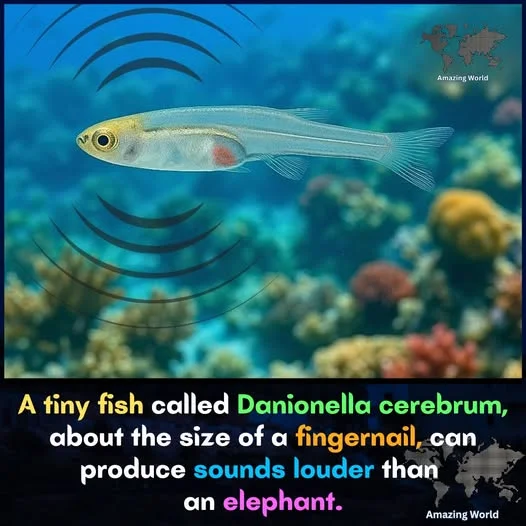
The Tiny Fish Louder Than an Elephant: The Amazing Story of Danionella cerebrum
Nature never stops surprising us. Just when we think we’ve seen it all, it reveals something so extraordinary that it changes the way we look at the world. One such marvel is a little fish called Danionella cerebrum — a creature so tiny it can fit on your fingernail, yet powerful enough to produce sounds louder than an elephant’s trumpet.
Yes, you read that right. This minuscule fish, barely visible to the naked eye, can create a sound that could rival one of the largest animals on Earth. It’s a fascinating reminder that in nature, size doesn’t always determine strength.
Meet Danionella cerebrum: The World’s Smallest Loudmouth
Danionella cerebrum is a small, transparent fish that lives in freshwater habitats in Southeast Asia. It belongs to the same family as zebrafish, but it’s much tinier — about 12 millimeters long, roughly the size of your pinky fingernail. At first glance, it looks delicate, almost fragile, yet this miniature marvel holds a secret superpower hidden within its body: sound.
Despite its size, this fish can produce sounds measuring over 140 decibels — that’s louder than a jet engine at takeoff or an elephant’s trumpet. The discovery shocked scientists who couldn’t believe such a small creature could generate such a powerful noise.
How Can a Tiny Fish Make Such a Loud Sound?
The secret lies in its unique anatomy. Researchers discovered that Danionella cerebrum uses a special structure near its swim bladder to create sound. By rapidly moving certain muscles and bones, it amplifies vibrations that travel through the water.
This mechanism works like a biological drum or amplifier. While most fish communicate using low-frequency clicks or grunts, Danionella cerebrum takes it to another level — producing sound bursts strong enough to travel across significant distances underwater.
In essence, it’s like the ocean’s version of a megaphone — only built into one of the smallest animals imaginable.
Why Does This Tiny Fish Need Such a Big Voice?
In the underwater world, communication is everything. Fish don’t text or tweet, but they do talk — through vibrations, colors, and sounds. For Danionella cerebrum, sound is its most powerful tool.
Scientists believe this fish uses its loud calls for mating communication and territorial defense. The males often compete to attract females by making strong, rhythmic noises. The louder the sound, the more dominant and attractive the fish appears to potential mates.
It’s a reminder that even in the smallest corners of nature, life finds incredible ways to adapt and stand out. Just like how birds sing and whales call across the ocean, this little fish uses its voice to survive and thrive.
The Science Behind the Sound
According to researchers, the sound production mechanism of Danionella cerebrum involves a rapid strike of specialized bones against a hollow chamber — similar to hitting a drum. These impacts create strong pressure waves that travel quickly through water, which is an excellent medium for sound transmission.
Because sound travels faster and farther underwater, even small vibrations can seem enormous to nearby listeners. Combine that with the fish’s rapid muscle contractions, and you get a sound powerful enough to astonish scientists around the globe.
A Lesson from the Little Fish: Size Doesn’t Define Power
There’s something poetic about this discovery. In a world where we often associate greatness with size or volume, this fish proves that impact isn’t always about being big — it’s about being effective.
Just like Danionella cerebrum makes its mark in the vast underwater world, we too can make an impact no matter how small we are. Whether it’s in our communities, workplaces, or families, our voice matters — and sometimes, the smallest voice can be the most powerful of all.
Think of how a kind word can change someone’s day, how a small act of courage can spark a movement, or how a single idea can shift perspectives. This tiny fish is a living symbol of that truth: you don’t have to be big to be heard.
Why Scientists Are Fascinated by Danionella cerebrum
Beyond its incredible vocal abilities, scientists are deeply interested in this species for another reason — its transparency. The fish’s nearly see-through body allows researchers to observe its brain activity in real time, making it a valuable model for neuroscience studies.
By studying how Danionella cerebrum produces sound and communicates, scientists can also learn more about how animals — and even humans — process sound, emotion, and behavior. It’s a small creature with potentially huge contributions to science and understanding life itself.
The Bigger Picture: Nature’s Hidden Wonders
What makes this discovery so magical is that it challenges our assumptions. We often overlook small things — insects, tiny fish, microscopic organisms — assuming they play minor roles in the grand scheme of life. But nature has a way of humbling us.
The story of Danionella cerebrum reminds us that every creature, big or small, contributes to the balance of our ecosystem. From pollinating bees to bacteria that recycle nutrients, even the smallest beings keep the planet running smoothly.
In a sense, this fish’s thunderous voice is a call to attention — urging us to listen to the whispers of nature that we too often ignore.
How You Can Appreciate the Small Wonders Around You
You don’t need a lab or telescope to experience wonder. It starts with awareness. The next time you’re near a pond, ocean, or even your backyard garden, take a moment to look closely. The world is full of small miracles — you just have to notice them.
Observe how ants cooperate, how birds communicate, or how water ripples after a raindrop. Each of these small details carries the same message that Danionella cerebrum teaches us: every life form has purpose and power.
Final Thoughts: The Power of the Tiny and the Mighty
In the grand concert of nature, it’s not always the loudest or largest that lead the symphony — sometimes, it’s the unexpected solo of a small fish echoing through the deep. The Danionella cerebrum may be small, but its voice is mighty, powerful, and unforgettable.
Its story reminds us to look closer, listen deeper, and respect even the smallest creatures that share our planet. Because when you think about it, life’s most profound lessons often come from the most surprising places.
Big impact. Small package. Endless wonder.
Now, that’s nature speaking — loud and clear.
