
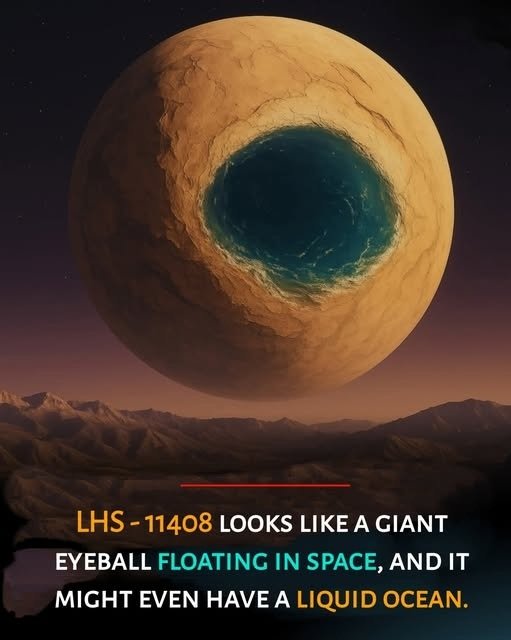
LHS 1140 b: The “Eyeball Planet” That Could Be Hiding Alien Oceans
Just 49 light-years from Earth, in the quiet constellation of Cetus, astronomers have discovered one of the most intriguing worlds ever found — LHS 1140 b. This distant exoplanet, often called the “eyeball planet”, might be the closest thing we’ve ever seen to an alien world capable of supporting life.
It’s not just science fiction — this world’s strange nature, stable environment, and potential for liquid water have made it one of the top candidates for habitability in the known universe. And the more scientists learn, the more extraordinary it becomes.
What Makes LHS 1140 b So Special?
LHS 1140 b orbits a small, cool red dwarf star — a type of star far dimmer and more long-lived than our Sun. Yet despite the faint light, this planet seems to rest in the “habitable zone” — the sweet spot where temperatures could allow liquid water to exist on its surface.
At about 1.7 times the size of Earth and roughly seven times as massive, it’s classified as a super-Earth — a rocky world larger than ours but not as large as gas giants like Neptune. But what really sets it apart is its appearance and climate behavior.
The Eyeball Planet: A World of Light and Darkness
LHS 1140 b is tidally locked, meaning one side always faces its star while the other side is trapped in eternal night. Imagine a world where the sun never rises nor sets — one hemisphere scorched in perpetual daylight, the other frozen in permanent shadow.
But between those extremes lies something remarkable — a twilight region where temperatures may hover around a comfortable 20°C (68°F). Here, scientists believe, lies the possibility of a massive circular ocean, nearly 4,000 kilometers across, glistening under the soft light of its red star.
Water — The Foundation of Life
Data from the European Southern Observatory (ESO) and NASA’s Exoplanet Archive suggest that water could make up as much as 20% of the planet’s mass. That’s an astonishing amount compared to Earth’s mere 0.02%.
This abundance of water, combined with a thick, nitrogen-rich atmosphere, could create the perfect conditions for a stable, life-supporting climate. The atmosphere may act as a shield — trapping warmth, preventing evaporation, and protecting the surface from harmful radiation.
If these findings are confirmed, LHS 1140 b might not just have oceans — it might have habitable oceans.
Why the Host Star Matters
Not all stars are friendly to life. Many red dwarfs, though small, are known to unleash violent radiation flares that strip nearby planets of their atmospheres. But LHS 1140, the star this planet orbits, is different.
It’s calm. It’s stable. And it emits minimal ultraviolet radiation. That means LHS 1140 b’s delicate atmosphere — and any water it holds — could remain intact for billions of years. This stability makes it one of the most promising places to search for life outside our solar system.
The Search for Signs of Life
The James Webb Space Telescope (JWST) and the HARPS spectrograph are now turning their instruments toward this world. Their mission: to study its atmosphere, measure its surface temperatures, and hunt for biosignatures — chemical fingerprints that could indicate life.
If JWST detects gases like oxygen, methane, or carbon dioxide in the right balance, it could mean biological activity. Even subtle variations could hint at living processes, like microbial respiration or photosynthesis-like chemistry.
These upcoming observations may finally tell us whether LHS 1140 b’s oceans are sterile — or alive.
Could Life Really Exist There?
Life as we know it depends on three key ingredients: liquid water, a stable energy source, and a protective atmosphere. LHS 1140 b appears to have all three.
Its warm ocean region might provide the kind of conditions where microbial life could thrive — perhaps even evolving over eons into more complex forms. The calm, dim light of its red dwarf star would shape life differently from Earth’s, possibly giving rise to alien ecosystems adapted to twilight skies and infrared light.
While we don’t yet know what those life forms would look like, this exoplanet gives us something priceless — hope. Hope that we are not alone in the universe, and that somewhere, under a red sun, another world breathes.
A Rare Opportunity for Discovery
Planets like LHS 1140 b are cosmic treasures. Their unique balance of water, stability, and atmosphere make them prime candidates for habitability studies. Every observation teaches us more about what makes a world truly livable — and what separates barren rock from blue ocean.
As technology advances, missions like JWST and ESO’s Extremely Large Telescope will continue to push the limits of what we can see. In time, they might even capture direct images of worlds like this — shimmering dots of light that could hold entire alien oceans.
The Future of the Search for Life
LHS 1140 b reminds us that the universe is not empty. It’s full of possibility. Each new discovery brings us one step closer to answering humanity’s oldest question: Are we alone?
If this world truly harbors life, it would mark a turning point in human history — proof that life can emerge wherever conditions allow, even under an eternal alien sun.
So the next time you look up at the night sky, remember — just 49 light-years away, in the constellation Cetus, a quiet planet may be carrying secrets older than our world, waiting for us to listen.
LHS 1140 b isn’t just another exoplanet. It’s a message — that life might be more universal than we ever dared to dream.
Credit: NASA Exoplanet Archive | European Southern Observatory (ESO) | The Astrophysical Journal (2025) | JWST & HARPS data
